


Brazil surprised me most when I stopped treating it like a single trip and started experiencing it like a continent stitched together by flights, bus rides, humidity, and wildly different daily rhythms. On my first visit, I thought I understood the basics after Rio: beach mornings, late dinners, and that Portuguese I kept accidentally bending into Spanish. Then I crossed the country again and again, landing in airports that felt like different nations and stepping into neighborhoods where the rules for getting around, paying, dressing, and even breathing in the heat all changed. This guide is built from what I actually did: the flights I took, the terminals I sweated through, the meals I pointed at on menus, the places I stayed, and the mistakes I made when I underestimated Brazil’s distances, seasons, and logistics.
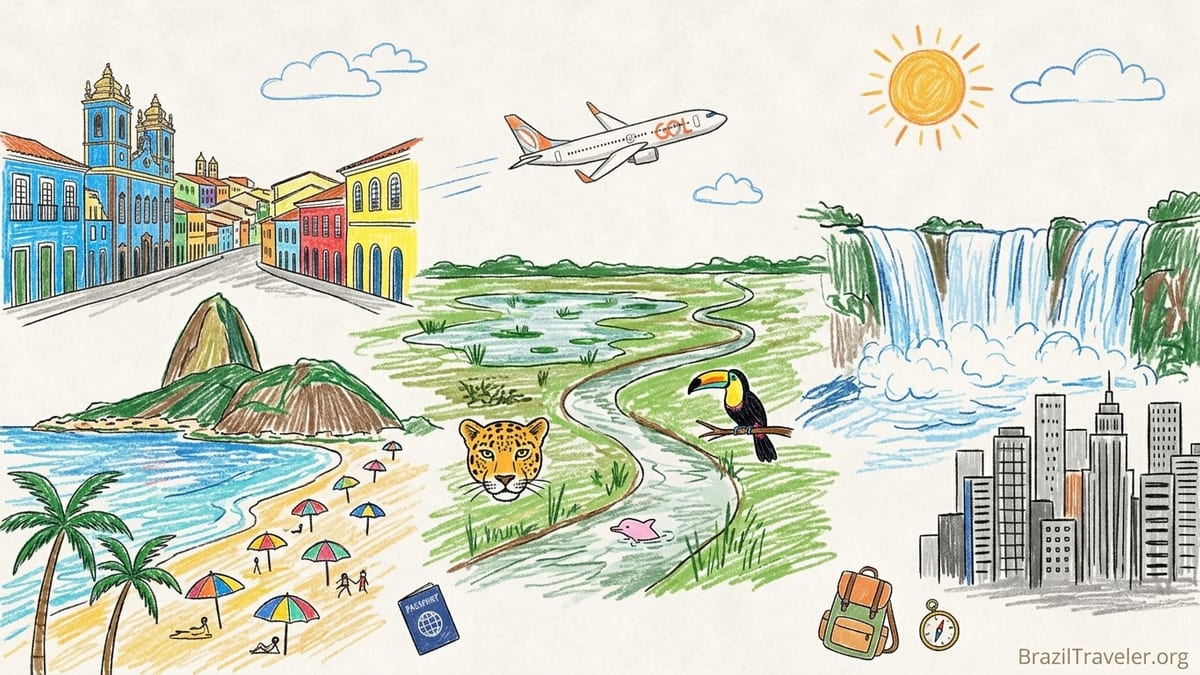
What Hit Me First: Brazil Is Not One Trip, It’s Many
I still remember the moment Brazil stopped being “Rio and beaches” for me: I was standing in a domestic terminal staring at a departures board that might as well have been a map of South America. I had already done the classic Rio arc, then connected through São Paulo, and later pushed north toward Salvador and Manaus. Each jump came with a new kind of heat, new street sounds, and new expectations for how you move through the day. In Rio I planned around beach weather. In the Amazon I planned around rain bursts and river time. In the Pantanal I planned around what season would even let me reach the wildlife corridors I cared about.
The distances were the gut punch. On a map, Brazil looks like a single country you can loop in a few weeks. In practice, the flight times, connection windows, and sheer fatigue of travel days turned my early itineraries into fantasy. I learned quickly to build Brazil in clusters, not in a single sweep. I also learned that the best experiences were rarely the ones I could “stack” efficiently. Some places needed slack time. Some routes needed a full reset day. Brazil rewarded me most when I stopped racing it.
Planning-wise, I now treat Brazil like a set of regions with their own calendars. The south can feel mild while the north is sauna-hot. The beach vibe in Florianópolis is not the beach vibe in Rio, and neither feels like the Northeast coast where tides and wind can dictate what a “good beach day” even means. If you’re trying to see more than one region, I’d rather you see fewer places properly than tick off cities and spend your trip in transit fog.
Entry Rules, Arrival Reality, and My First Airport Lessons
I’ve arrived in Brazil through the big gateways and felt the difference immediately: international arrivals can be smooth, but the handoff into domestic travel is where the country reveals its scale. A detail worth checking at publication time is Brazil’s electronic visa requirement for certain nationalities. As of the current official guidance, U.S., Canadian, and Australian passport holders need an electronic visitor visa (eVisa) for tourism and business travel, a rule that took effect on April 10, 2025, and applications are handled through the official eVisa channel referenced by Brazil’s Ministry of Foreign Affairs.
What I tell friends now is simple: treat your entry paperwork like a flight, not a formality. Apply early enough that you’re not refreshing inboxes at midnight. Also, do not rely on “it worked for someone last month.” Airlines follow documentation databases and can deny boarding if your paperwork is off, even if you plan to sort it out on arrival. I’ve watched stressed travelers at check-in counters try to argue their way into the air. It rarely ends well.
Connectivity matters, too. Brazil’s main hubs can make your itinerary feel easy, but your actual experience depends on connection timing and where you’re going next. Some routes are frequent and forgiving. Others run limited schedules that can strand you overnight if you miss a connection. My main mistake early on was planning domestic flights too tightly after international arrival. By the time you clear arrival steps, find the right terminal area, and re-orient yourself, those “perfect” two-hour connections can become a sprint.
Rio de Janeiro: The Neighborhood Shock, the Beach Reality, and the Day I Fried
Rio is the place where Brazil first felt cinematic to me, but it also taught me how quickly conditions can flip. I stayed in the South Zone, bouncing between the comfort of Copacabana’s nonstop movement and Ipanema’s slightly more polished rhythm. A few blocks could change everything: street energy, noise levels at night, and how comfortable I felt using my phone openly. In the morning I’d walk toward the beach with a coffee, and by midday the sun felt like a physical weight pressing down.
The beach reality surprised me. I expected perfect turquoise calm, and instead found a coastline that changes mood by the hour: choppier water on some days, stronger waves on others, and a constant need to watch the flags and the lifeguard areas. I learned to ask simple questions in Portuguese and accept that my accent would get me gently corrected. I also learned that Rio rewards early starts. When I tried to do “lazy beach mornings,” I often ended up arriving when the heat peaked and the sand felt like a skillet.
The biggest personal lesson in Rio was how fatigue compounds. One night out, one long walk in midday heat, one late meal, and suddenly the next day feels like you’re moving through glue. Rio made me change how I schedule: I now plan one anchor activity per day, not three. If you’re visiting in Carnival season, I would plan as if the city will be louder, slower, and more expensive than you expect. Carnival timing shifts each year, and official parade schedules and street events can start long before the peak dates. For Rio Carnival 2027, the headline dates are in early February, with street Carnival activity beginning weeks earlier and the main parade nights in the Sambadrome falling across the Carnival period, so you want lodging locked well ahead if those dates overlap your trip.
São Paulo: The City That Changed How I Think About Brazil
São Paulo surprised me because it didn’t feel like a “tourist stop,” yet it became one of the most useful places I visited. After beach-first Rio, São Paulo felt like a hard pivot: bigger buildings, faster sidewalks, and a rhythm that makes you feel underdressed if you show up in flip-flops. I stayed in areas where I could walk to meals and coffee without thinking too hard, and I quickly realized that São Paulo is the city where Brazil’s variety shows up on a plate.
Meals in São Paulo became my cheat code for understanding the country’s layers. I’d order something simple, then end up in conversations about where ingredients came from, or how a dish changed from region to region. Even my language interactions felt different: people were direct, helpful, and used to the pace of a big global city. I still used my basic Portuguese, still slipped into Spanish occasionally, and still got saved by patience and context.
Practically, São Paulo also helped me with logistics. It’s one of the easiest places to thread together domestic flights, because you can connect to almost anywhere. If your Brazil trip is ambitious, São Paulo is often the hinge. I now like to schedule São Paulo between regions as a reset: laundry, good sleep, a calm meal, then fly again. It’s not that São Paulo is “relaxing,” it’s that it’s functional, and function matters when you’re covering a country this large.
Salvador, Bahia: Heat, History, and the Rhythm Shift
Salvador was the moment Brazil felt most like it was operating on its own internal clock. The air was thicker, the heat more immediate, and the cultural texture felt different from the south within a single afternoon. I stayed in neighborhoods where I could walk to historic areas and still retreat when the sun hit its loudest point. Salvador taught me to build my day around shade: mornings for exploring, afternoons for slower meals, and nights for music and movement.
I made the classic mistake of underestimating humidity. I’d step outside feeling fine and come back drenched, as if I’d been caught in rain. This is where I started carrying water constantly and paying more attention to what locals were doing: short sleeves, steady pace, breaks without guilt. I also ran into the payment reality that repeats across Brazil: cards work widely, but not universally, and some small vendors prefer instant transfers. Brazil’s payment ecosystem is modern and fast, and the country’s instant payment system, Pix, is deeply embedded in everyday commerce. As a foreign traveler, you may not always be able to use Pix directly without local banking access, which can make cards and cash backups feel less optional than you’d expect.
Salvador also changed how I think about time allocation. I originally planned it as a quick stop. I regretted that. Salvador is the kind of place where you want extra days, not because you need more “attractions,” but because it’s a city you feel through pace, food, and street life. If I rebuilt my route, I’d give Salvador more time and trim something else, especially if the choice is between another connection day and actually having space to be present.
Foz do Iguaçu: The Falls, the Rules, and Why I Needed Two Days
Foz do Iguaçu looked like an easy win on my itinerary: fly in, see the falls, fly out. I was wrong. The falls are overwhelming in the best way, but the logistics can be more structured than people expect. Ticketing is time-based, and there are specific entry windows and rules that shape your day. I learned to book ahead and show up early, because the experience changes with crowds and heat. By late morning, the walkways can feel packed, and the sun reflecting off mist can turn the air into a bright haze.
What surprised me most was how much I wanted a second day. The first day I was in awe, but also tired, moving too fast, trying to see everything. The second day, I slowed down, paid attention to viewpoints, and let the noise become part of the experience instead of something I rushed past. If you’re pairing the park with nearby attractions like the bird park, plan it deliberately. Parque das Aves, for example, posts its pricing and validity windows publicly and is not something I’d squeeze in at the end of a day when you’re already sun-drained.
Also, respect the park rules and the concessionaire structure. In Brazil’s federal conservation units, visitation systems can involve specific registration data requirements, and I’ve found it’s best to carry the same identity document you used to book. If you’re the kind of traveler who likes spontaneity, Foz can still work, but you’ll enjoy it more if you treat it like a “reservation destination” rather than a casual stopover.
Manaus and the Amazon: The Rainy Truth, River Time, and the Tour Choice That Mattered
Landing in Manaus was like stepping into a different atmosphere, literally. The heat felt wet. The air smelled like vegetation and river. I remember walking out and feeling my shirt cling instantly. This is where Brazil’s weather stopped being a backdrop and became the main character. I built my Amazon experience around guided excursions rather than trying to improvise independently, because distances on the river are real, navigation is not intuitive, and safety is not the place for ego.
My biggest surprise in the Amazon region was that “close on the map” means nothing. Trips that look short can take hours, and the experience is shaped by water level, season, and whether you’re traveling by road, boat, or a mix. The choice of tour operator mattered more here than anywhere else I went in Brazil. I chose an itinerary that included transfers between Manaus and river towns and prioritized being on the water early, when the light is softer and wildlife viewing feels more alive.
Practically, I’d tell first-timers to plan the Amazon with humility: expect rain, expect sweat, expect schedule flexibility. Pack for wet conditions even if the forecast looks “fine.” Also, bring payment backups. Cards may work in Manaus, but once you move into tour logistics and smaller stops, connectivity and preferred payment methods can shift quickly. If your operator asks for specific payment methods, ask early and confirm what works for foreign cards.
Pantanal: Where Seasonality Decided Everything
The Pantanal was the region that most clearly punished bad planning. I went in expecting “wildlife like a documentary,” and I did get that feeling, but only because I adjusted my timing and expectations. This is a place where the season changes access. Official guidance for the Pantanal region notes that the better visitation window is typically in the drier months, roughly May to September, when rainfall is lower and wildlife viewing improves as waters recede. In wetter months, rain can make routes difficult, mosquito pressure rises, heat intensifies, and key access roads can become close to impassable.
What I felt personally was the difference between “hot” and “hot with consequences.” When it’s dry, you can spend long periods outdoors and actually enjoy it. When it’s wet, everything is heavier: clothing, air, travel times, and your own stamina. I also learned that the Pantanal is not a place to wing it if you want specific wildlife outcomes. You need local knowledge: what time to be on the water, which tracks are usable, and how conditions have shifted in the last week.
If you’re building a Brazil itinerary, the Pantanal is where I’d anchor the whole trip’s season first, then fit the rest around it. It’s also where I’d pad extra time. Travel days into the region can be long and tiring, and once you’re there, you’ll want enough nights that you’re not doing a single rushed outing and then immediately leaving.
Florianópolis: The Beach Destination That Didn’t Behave Like the Tropics
Florianópolis surprised me because it’s a beach destination that doesn’t always give you “tropical” water. Coming from warmer coasts, I expected that automatic bathwater feeling. Instead, I got a southern island with real seasonality, changing water temperatures, and beaches that behave differently depending on which side of the island you’re on. Some days were perfect: bright sun, comfortable water, long afternoons. Other days reminded me quickly that the South Atlantic can run cooler, and that wind can change the mood of a beach faster than clouds do.
I stayed in areas that made it easy to reach different beaches, because that’s the key to Florianópolis: choice. You can chase calmer bays or stronger surf depending on conditions. I learned to ask locals which side was best that day, and to treat the island like a collection of micro-destinations rather than one beach town. Traffic also surprised me in peak summer. A short ride can stretch out if you move at the wrong time, and that can quietly ruin a day if you’re trying to “do three beaches” instead of one good one.
From a planning angle, Florianópolis is most enjoyable when you respect its calendar. Peak season crowds and prices surge in the Brazilian summer, especially December through February, and the shoulder months can be a sweet spot if you want warmth without the full crush. If you’re pairing Florianópolis with Rio, expect a shift: it feels more domestic, more spread out, and less like a single iconic strip you can walk end-to-end.
The Takeaway
What surprised me most about Brazil wasn’t one view or one meal. It was how completely the country changed every time I crossed into a new region. Rio taught me to respect heat and pace. São Paulo taught me how useful a hub can be. Salvador taught me to slow down and plan for humidity. Foz do Iguaçu taught me that “one day” can be a trap. Manaus and the Amazon taught me that logistics are part of the experience, not an interruption. The Pantanal taught me to let seasonality choose my dates. Florianópolis taught me that beach trips still require weather intelligence.
If I rebuilt my first multi-region route, I’d do fewer transitions, add rest days between climates, and stop pretending that Brazil’s size is an abstract fact. It’s a physical reality you feel in airport corridors, on long transfer days, and in that moment when you realize your next destination is not “nearby,” it’s a flight away. Brazil rewards travelers who plan with structure but leave room for the country to change them in real time.
FAQ
Q1. Do U.S., Canadian, and Australian travelers currently need an eVisa for Brazil?
As of the latest official guidance, yes. The eVisa requirement for U.S., Canadian, and Australian passport holders is in effect for tourism and business travel, and you should confirm requirements again right before booking flights.
Q2. Which cities are easiest for international arrivals and onward domestic connections?
In practice, Rio de Janeiro and São Paulo are the most common gateways, and São Paulo is often the most flexible hub for connecting onward to other regions.
Q3. How many days should I allocate for Rio if I also want other regions?
I would plan enough time to experience neighborhoods and beaches without rushing, and I would avoid stacking too many major day trips back-to-back in the heat.
Q4. Is Foz do Iguaçu doable as a quick overnight?
It’s possible, but I found it much better with at least two days so you can see the falls without racing crowds, heat, and ticketed entry windows.
Q5. Do I need to reserve attractions in advance in Brazil?
For major draws like Iguaçu Falls ticketing and certain high-demand events, yes. For many city activities, you can be more spontaneous, but reservations reduce stress during peak periods.
Q6. When is the best season for the Pantanal?
Official guidance indicates the best visitation period is generally in the drier months, roughly May through September, when access improves and wildlife viewing is often better.
Q7. What’s the biggest mistake travelers make with the Amazon from Manaus?
Underestimating river distances and overestimating how easy it is to improvise. A well-run guided itinerary can make the experience safer and far more rewarding.
Q8. Can I rely on credit cards everywhere in Brazil?
Cards are widely accepted in many cities, but you should carry a backup plan. Some smaller vendors prefer instant transfers, and remote areas can have connectivity issues.
Q9. What should I know about Pix as a visitor?
Pix is a dominant everyday payment method in Brazil, but many foreign travelers can’t use it directly without local banking access, so plan for cards and some cash where needed.
Q10. How should I structure a multi-region Brazil itinerary to avoid burnout?
Cluster destinations by region, minimize cross-country jumps, add recovery days after long transfers, and let seasonality determine where you go first.