


Manaus looks like a full-sized city because it is one. There are ride-share cars, riverfront high-rises, and the kind of airport arrival where you can still grab a decent coffee before you disappear into the world’s largest rainforest. That contrast is exactly what makes Amazon tours from Manaus feel so cinematic: one moment you are in traffic near the Teatro Amazonas, the next you are watching the dark Rio Negro slide past the mud-colored Solimões at the Meeting of the Waters, heading toward a lodge that runs on generators and schedules your shower around electricity hours. I booked a multi-night jungle lodge package instead of a day trip, and this is what the transfer, the stay, the excursions, and the isolation really felt like.
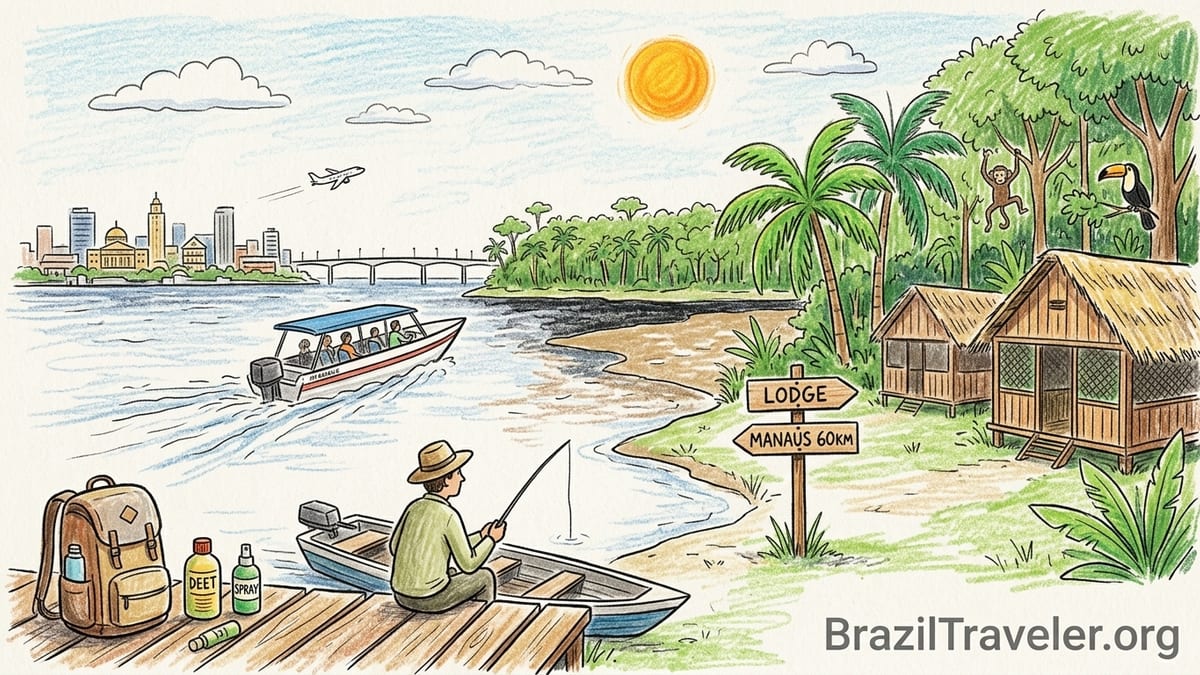
Starting In Manaus: The Airport Arrival And The One-Night “Staging” Plan
I landed in Manaus with a practical goal: sleep one night in town, then leave early for the lodge before the day heats up. Many lodge packages can collect you straight from the airport, but I chose a hotel night because (1) delayed flights happen, (2) you want time to buy bug spray and long sleeves you actually like wearing, and (3) the packing you thought was “fine” suddenly feels optimistic once you walk outside into the humid air.
Manaus remains the major gateway for reaching jungle ecolodges and river cruises across the biome, and the logistics radiate outward from the city. Some lodges run road-only transfers up the Rio Negro side toward Novo Airão and the Anavilhanas archipelago, while others use the classic road-and-boat combo toward Careiro and the Paraná do Mamori and Juma River regions. I intentionally picked the road-and-boat style because I wanted the transition to feel gradual: city, port, fast boat, highway, then smaller boat into narrower channels.
That night in town, I used the time for two non-negotiables. First, I checked my repellent plan: in Brazil, repellents must be registered, and national health guidance emphasizes choosing effective actives such as DEET, icaridin, or IR3535, then following label instructions. Second, I reviewed malaria and fever guidance. Brazil’s Ministry of Health stresses mosquito avoidance and prompt evaluation for symptoms after Amazon-area travel, and the U.S. CDC continues to flag malaria risk across Amazonas state, meaning travelers should discuss prophylaxis and bite prevention with a travel clinic before going.
Pickup In Manaus: Hotel Door To Port To Fast Boat (And The First Reality Check)
My lodge package included pickup in Manaus, and the first “Amazon tour” moment was surprisingly ordinary: a van at the hotel entrance, a quick headcount, and bags loaded with the efficiency of people who do this every single morning. It was not luxury, but it was organized. You could feel the shift from “tourist service” to “transportation system.” The driver knew exactly where to stop, when to wait, and how long each leg should take.
From central Manaus, we headed to the Ceasa port area, where the river becomes the highway. This is where I had my first reality check about what “remote” means here. The Amazon is not one river. It is a huge network of rivers, channels, lakes, and flooded forest corridors. Your lodge might be only a few dozen miles away as the macaw flies, but the route includes transfers, docks, and timing that depends on water levels and safe navigation.
Once on the fast boat, the skyline dropped away quickly. The engine noise, the spray, the sun on the water, and the sudden openness made it feel like a clean break from town life. As we pushed out, the water surface looked deceptively calm, but the boat driver read it like a map: avoiding wakes, adjusting for floating debris, and lining up for the smoother channels.
On this route, the Meeting of the Waters is not a postcard stop so much as a moving landmark. The dark Rio Negro and the lighter Solimões run side by side without immediately mixing, and you can watch the seam drift and bend as boats cross it. If you have only ever seen photos, the scale is what surprises you most: it is not a “spot,” it is a broad, living edge in the middle of a working waterway.
The Road Leg And The Second Boat: How Long It Actually Took (And What The River Felt Like)
After the first boat crossing, we shifted to a road leg. In my case, the rhythm was roughly: vehicle to port, speedboat across the big river system, then van or car again toward the smaller river access point, followed by another boat into the lodge area. Lodges in the Careiro and Mamori areas often describe this as “car and boat” transfers, and some public itineraries spell out travel times of about an hour by road followed by a shorter boat ride into the lodge zone, depending on which property and which channel they use.
This middle section is where the Amazon feels most like a real place with real people, not just “jungle.” You pass small settlements and roadside activity, and the forest wall is close enough that you stop thinking of it as scenery and more like a physical presence. The air is still humid, but on land it feels heavier, less breezy, and more enveloping than on the open water.
Then came the second boat. The river conditions shifted from wide, expressive water to narrower passages where you notice details: the color of the water, the weeds along the edges, the insects hovering near the surface, and the occasional log that looks like it has been traveling for days. If you are visiting during lower-water months, navigation can slow as captains thread through shallower, winding channels around sandbars. Water-level seasonality around Manaus is not abstract. Scientific and operational records show the Rio Negro’s high-water period tends to peak around late May through July, with lower water typically around October to December, and that timing affects what you can access and how you access it.
By the time the lodge boat turned off the main channel, the outside world felt like it had been folded away behind a curtain. You still hear engines, but they sound distant. You still see signs of people, but they are spaced farther apart. It is not the silence of emptiness; it is the layered sound of living forest.
Arrival At The Jungle Lodge: The Cabin, Electricity Hours, And Mosquito Defense That Actually Worked
My arrival looked like this: a wooden dock, staff waiting with practiced calm, and a welcome drink that tasted like it belonged here (cold, fruity, and fast). The dock area doubled as the lodge’s front porch. There was no lobby in the city sense. Check-in was quick because most of the information was already collected in Manaus. The lodge staff explained the daily schedule, meal times, and the practical rules that matter in the Amazon: where to refill water, when electricity runs, and how to signal if you need help at night.
My room was a simple cabin-style setup with screened openings and a mosquito net over the bed. It was clean, not ornate. The bed net was the key feature. I learned quickly that mosquito protection is not a single product, it is a system: long sleeves at dusk, repellent on exposed skin, net at night, and a habit of keeping doors shut rather than “just for a second” leaving an opening.
Electricity was limited to set hours, powered by a generator. That shaped everything. You charged devices as soon as the power came on, and you did not waste the window by forgetting to plug things in. The fan worked during electricity hours, and when it was off, the air still moved less than I expected. Humidity did not disappear at night. It simply changed texture, becoming cooler but still saturated, like a damp cloth laid over the skin.
The shower was functional and refreshing, but not something you lingered in. Hot water was not guaranteed at all times. Water pressure was fine when the system was running, and then it could be lighter depending on usage. I stopped thinking of it as “hotel infrastructure” and started seeing it as a small miracle: clean water, a working drain, and the ability to rinse off sweat and river spray in the middle of the rainforest.
Meals, Heat, And The Night Soundtrack: How Isolated It Really Felt
Meals were served in a central dining area on a set schedule, and they did not feel like an afterthought. The food leaned heavily on regional staples: rice, beans, salads, and fish when it was on the menu, with fruit that tasted fresher than anything I had eaten in the city. I am careful about claiming what every lodge serves because menus vary, but the core reality was consistent: you ate what arrived, when it arrived, and you ate enough because the day’s activities and the heat make you hungry in a very straightforward way.
The most challenging part of the day was not an excursion. It was the hours of stillness between tours when the humidity sat on you and your clothes never fully dried. Even in Manaus, humidity is high, and in the forest it feels amplified by shade, vegetation, and the fact that you are constantly near water. I brought quick-dry clothing and still found that “quick” is relative when the air is already holding as much moisture as it can.
At night, the lodge felt genuinely isolated. Not “remote resort” isolated, but “the darkness is complete” isolated. If you have only been in cities, you may not realize how much ambient light you are accustomed to. Here, once the generator hours ended and pathways went quiet, the property became a small island of human structure surrounded by deep forest and water.
The sounds were the most immersive part: insects that rose and fell like waves, frogs calling from the edges, and occasional movement in the trees that you could not see. The forest did not sound scary so much as busy. It felt like the lodge was borrowing space for the night rather than owning it.
The Excursions I Actually Took: Canoes, Walks, Night Spotting, And What We Truly Saw
My lodge schedule followed the classic Amazon rhythm: an early morning activity before the heat builds, a midday break, then an afternoon outing, and sometimes a short night excursion. Travel time is part of the experience. You do not just “go see wildlife.” You move through habitat, and the movement can take longer than the viewing.
On our canoe trips, the standout wildlife encounter was river dolphins. We saw dolphins surface near the boat in calmer water, and even though you can never control how long they stay, the moment landed because it felt earned. We also saw monkeys in the treetops on a separate outing, not close enough for a perfect photo but close enough to identify movement patterns and hear the calls. Birds were the most consistent sightings: small groups moving over the water, flashes of color in the canopy, and loud calls that carried across the channel.
The night excursion was the most visceral. We moved slowly by boat with a spotlight scanning the banks. That was the outing where we saw caimans: eyes reflecting back as small points of red-orange light. The guide did not overpromise. We did not “find everything.” We saw a few, at a distance that felt respectful, and then we moved on, letting the forest return to itself behind us.
On the forest walk, the guide focused on what was guaranteed: the ecology, the medicinal and practical uses of plants, and the signs you can reliably read. We did not see a sloth on my walk, and that is worth saying because sloths are often used as marketing bait. What we did experience was the physical reality of the forest floor: roots that force you to watch every step, sweat that starts immediately, and a constant awareness of how far you are from a paved surface. The walk was not extreme, but it was not effortless either, especially in humidity that makes your body work harder than usual.
Fishing was included as a short session rather than an all-day obsession. I did not land a dramatic trophy fish, but the experience was still satisfying because it was simple: a line in dark water, guides explaining technique, and the sense that even “a casual hour” consumes time in the Amazon because everything is done by moving through space.
Packages, Seasonality, And Responsible Tourism: What I Learned By Comparing Options
Once I was back in Manaus, I compared lodge styles more carefully, because choosing the right package changes the trip. Some properties publish clear 2026 package pricing and inclusions. For example, Amazon Ecopark Lodge lists 2026 per-person package rates in U.S. dollars and describes what is included for a 2-night program, including meals and scheduled transfers, while also noting extra charges for certain evening airport transfers. Amazon Turtle Lodge listings also publish 2026 per-person pricing in U.S. dollars with different seasonal rates and describe inclusions like accommodation, transfers as outlined, meals on schedule, and listed excursions, excluding drinks and items like insurance. Higher-end experiences like Juma Amazon Lodge publish 2026 rates in Brazilian reais by season and room view category, reflecting how quickly prices can scale with remoteness and lodge design.
Those published examples helped me understand what “included” really means in practice. Most lodge packages from Manaus bundle transfers, full board meals (excluding drinks), and a fixed menu of guided outings. The trade-off is flexibility. You do not improvise much, because transport and safety depend on group timing and water conditions.
Seasonality is not only about rain. It is about access. In higher water months, you can often canoe deeper into flooded forest corridors that are inaccessible in low water. In lower water, beaches and sandbars can appear, and some jungle trails can be easier, but navigation can become slower in shallower channels. Around Manaus, hydrology studies and long-running river records consistently describe a mid-year high-water period and late-year low-water period, and that pattern shapes which lodge region you might prefer.
Responsible community tourism matters here, and it is worth being choosy. Not every “community visit” is the same. I looked for operators that describe community-based experiences as partnerships rather than performances, and that avoid sensationalism around wildlife interaction. A good guide framed our visit as a chance to learn about daily life and river logistics, not a staged show. If a sales pitch leans too hard on “guaranteed” wildlife or promises hands-on animal contact, that is your cue to slow down and ask more questions before you pay.
The Takeaway: How Many Nights I’d Book Next Time (And Lodge vs. River Cruise)
If you can only do two nights, you can still have a meaningful Amazon experience, but you should accept the math: day one and day three contain a lot of transfer time. A two-night package gives you one true full day on-site plus arrival and departure outings depending on timing. That can be enough for travelers on tight schedules, but it feels fast.
Three nights felt like the sweet spot for me. With three nights, you get two full days of excursions plus enough downtime to absorb the place: sitting on the dock, watching the river change color with the light, and realizing how quickly your brain adapts to the forest’s sounds. Four nights would be better if you want more chances at wildlife encounters, because sightings are not scheduled, and repeating the same type of habitat at different times of day can completely change what you notice.
Would I choose a lodge again or try a river cruise next time? I would likely choose a lodge again if my goal is learning: slower routines, repeated outings in the same ecosystem, and time to feel the isolation. I would choose a river cruise if my priority is variety and comfort: covering more territory, sleeping in a moving base, and trading “deep stillness” for “wider geography.” Manaus makes both styles easy to access, but the emotional texture is different. A lodge feels like you joined the forest for a few days. A cruise feels like you traveled through it.
My strongest recommendation is simple: choose your lodge based on logistics and honesty, not just photos. Look for packages that clearly state what transfers are included, which meals are included, how electricity works, and which tours are actually scheduled. In the Amazon, clarity is comfort, and comfort is what lets you pay attention to the rainforest instead of worrying about the basics.
FAQ
Q1. How do most Amazon lodge transfers from Manaus work?
Most packages include a multi-leg transfer that can combine hotel or airport pickup, a road segment, and one or more boat segments, depending on the lodge region.
Q2. Is the Meeting of the Waters usually part of the route?
Often yes on routes that use the Ceasa port and cross toward Careiro, but some Rio Negro lodges use mostly road transfers and may not include it.
Q3. Do lodge packages typically include meals?
Many do include full board meals on a set schedule, while drinks are often extra. Always confirm what “full board” means for your specific package.
Q4. Will I have electricity all day at a jungle lodge?
Not always. Many lodges run generators on set hours, which affects fan or air-conditioning time and when you can charge devices.
Q5. What mosquito protection should I plan for in Amazonas?
Plan layered protection: long sleeves at dusk, a registered skin repellent with proven actives, and a bed net or screened room at night.
Q6. Do I need malaria pills for a Manaus Amazon lodge trip?
Amazonas is a malaria-risk state. Whether you should take prophylaxis depends on your exact itinerary and health profile, so consult a travel clinic before departure.
Q7. What wildlife is realistic to see on a lodge stay?
Birds are common, and sightings of dolphins or caimans can happen on the right outings, but no operator can ethically guarantee specific animals on a specific day.
Q8. How many nights is best for a first Amazon lodge trip?
Three nights is a strong first choice because it usually gives you two full days on-site, while two nights can feel rushed due to transfer time.
Q9. When is high water vs. low water near Manaus?
High water typically peaks around late May through July, while lower water is more common around October to December, though exact timing varies year to year.
Q10. Should I choose a jungle lodge or a river cruise from Manaus?
Choose a lodge for deeper immersion in one area and a cruise for broader coverage and a floating base. Your best pick depends on whether you value stillness or variety.