


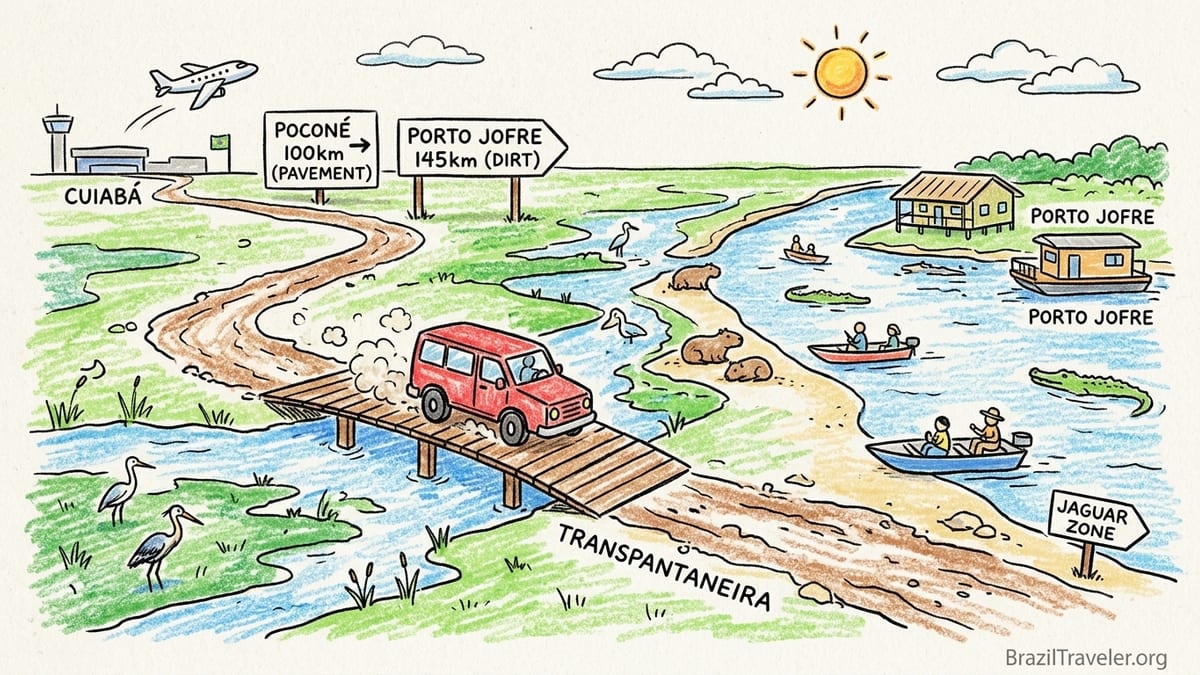
I came to the northern Pantanal for one animal and a thousand smaller moments: the heavy air at dawn, the metallic click of camera shutters, and the slow arithmetic of searching. I entered via Cuiabá, then rode the classic jaguar corridor down to Porto Jofre at the end of the Transpantaneira. Official tourism materials describe that approach as roughly 100 km of pavement to Poconé, followed by about 145 km of dirt road across a web of bridges. On paper, it is simple: drive, arrive, board a boat, find a jaguar. In real life, the Pantanal makes you earn every sighting, and it teaches you to pay attention even when the headline animal does not appear on your schedule.
Gateway Choices: Why I Entered Through Cuiabá, Then Committed to Porto Jofre
If you are coming primarily for jaguars, the northern Pantanal’s Porto Jofre area is still the most straightforward base, and Cuiabá (served by Marechal Rondon Airport in Várzea Grande) is the gateway that makes the logistics doable in a short trip. I chose it for a practical reason: most jaguar-focused operators and lodges run their transfers on the Cuiabá to Poconé to Porto Jofre line, which is built around a same-day drive and then daily boat safaris on the Cuiabá River and its side channels.
The alternative gateways are real and worth naming because they change the feel of your trip. You can approach the Pantanal via Mato Grosso do Sul, including Corumbá, and then go by river toward protected areas like the Pantanal National Park, where access is explicitly described as fluvial from Porto Jofre down the Cuiabá River or from Corumbá up the Paraguay River. That route leans more toward multi-day boat-hotels and broader wetland scenery. It is not inherently better or worse, but it is a different trip. I wanted the focused, jaguar-centric routine that Porto Jofre is known for: long days on fast boats, scanning sandbanks, and waiting for a radio call that changes everything.
Even before leaving Cuiabá, the season question shaped my expectations. Government tourism guidance for the Pantanal emphasizes that flood and dry cycles define what visitors will find, and it labels May through September as the best window for higher jaguar chances because animals move more freely as waters drop. That same guidance warns that October and November can be brutally hot, and that heavy rains shift the experience toward boats as mammals retreat to higher ground. I traveled with that mental model: chase the dry-season advantages, but accept that nature does not schedule itself for my itinerary.
The Transfer: 100 km of Pavement, Then Dirt, Bridges, Dust, and Patience
My transfer followed the route most first-time jaguar travelers hear about: Cuiabá to Poconé on pavement, then down the Transpantaneira to Porto Jofre on dirt. Official lodging information in Porto Jofre describes it plainly: about 100 km of paved road to Poconé and then about 145 km of dirt road to the riverfront hotels, crossing a long chain of bridges. Mato Grosso mapping material for the Transpantaneira highlights the same scale and adds a detail you feel in your bones while riding it: roughly 145 km and well over a hundred bridges. The numbers are useful because they explain why “short” distances can still take real time.
Road conditions are the part of Pantanal travel most people underestimate. In the dry season, the dirt sections can be fast enough to lull you into thinking it will stay easy, until corrugations rattle the vehicle and the dust becomes a second climate. In the wet season, official protected-area guidance warns that the Transpantaneira can become close to impassable with rain, especially deeper into the summer months, and it specifically flags access to Porto Jofre as difficult when the rains hit hard and mosquitoes surge. That is not a scare tactic; it is practical planning. If your trip is fixed for January or February, you should treat road access as a risk factor, not a footnote.
My ride was in an air-conditioned transfer vehicle, the kind most packages use. It was comfortable, but the comfort ended every time we opened doors to stretch, check a bridge approach, or step out for a quick look at movement in the grass. Dust coated shoes quickly. The sunlight felt sharper the farther we went, and the landscape shifted from city edges into a wide, flat world where water and land negotiate daily.
Basecamp on the River: Choosing a Lodge Versus a Houseboat in Porto Jofre
I based myself in Porto Jofre rather than staying farther north along the Transpantaneira, because that puts you where the boat time is spent searching instead of commuting. Porto Jofre accommodations split into two main styles for jaguar travelers: riverfront lodges and houseboats. Both can work, but they create different days. A lodge gives you a fixed room, a routine dining area, and usually quicker gear organization. A houseboat keeps you immersed in the river environment and can reduce the daily back-and-forth if the operator positions it for the search zones.
In current, bookable market terms, the price differences can be significant depending on inclusions and group size. Some operators publish two-person package pricing for five days and four nights with accommodations in Porto Jofre, explicitly offering either a houseboat cabin or a private cabin style at similar price points. Other operators sell small-group, date-specific 2026 departures with published per-person prices, often peaking in September. Those concrete numbers matter because the Pantanal is not a place where you want to arrive without a plan and hope it will be cheap. The jaguar zone is remote, capacity is limited, and peak-season demand is real.
I chose a river-based program that prioritized time on the water over extra inland activities. In practice, that meant: early breakfast, load into boats with day gear and camera protection, and spend the longest blocks of daylight scanning. The lodge or boat becomes a staging area for an effort that is less safari-drive and more river search.
Dawn Starts and the Reality of the Pantanal: Heat, Glare, Mosquitoes, and the “Long Scan”
Jaguar tours get marketed with dramatic photos, but the daily reality is built from less photogenic sensations: glare off water, sweat that appears the moment the sun clears the horizon, and the discipline of looking at the same bank for the tenth time because a guide noticed something you missed. In the late dry season, government tourism guidance warns of extreme heat in the region, and that was my constant companion. Even when the morning began cool enough to feel promising, the temperature rose quickly and stayed high.
Mosquitoes were not a constant wall for me the way they can be in the wetter months, but they appeared whenever we lingered in sheltered vegetation or when wind dropped. Protected-area guidance specifically notes that mosquito numbers increase heavily from December onward, alongside intense heat and rain. Even traveling outside that peak, I packed long sleeves that breathed, a head net that I did not always wear but never regretted bringing, and repellent that I treated like essential equipment rather than an optional comfort.
And then there is the dust, which seems like a road problem until you realize it becomes a gear problem too. Camera bodies, binocular hinges, zippers on day packs, even water bottle caps pick up grit after a long transfer on the Transpantaneira. The practical move is to keep sensitive gear in sealed bags, carry a small cloth, and accept that Pantanal travel is not a clean-room hobby.
On the Water: Boat Conditions, Search Etiquette, and What I Actually Saw While Looking for Jaguars
Porto Jofre’s jaguar safari is a boat safari. You are not tracking cats from a jeep across open savanna; you are reading river edges, listening for bird alarms, and watching for movement that could be a tail flick or a shadow shifting under a tree. The boats I used were the typical Pantanal search style: open, low-profile, built for speed and maneuvering, with enough space for a small group and gear. They were functional rather than luxurious, and that felt right for the job. The river is the road here.
Boat traffic is part of the Porto Jofre equation. When a cat is found, other boats tend to converge, sometimes quickly, because guides communicate and because jaguar tourism has become an organized economy in this corner of the Pantanal. The upside is that the collective effort raises the odds that a sighting is shared. The downside is that crowding can happen, and it changes the tone of an encounter. I planned my days expecting that: sometimes it would feel like a quiet, private scan; sometimes it would feel like a floating gallery of lenses.
While searching, I did see a lot of wildlife, but I am careful about what I name because this trip was about not turning the Pantanal into a checklist. I saw capybara and caiman repeatedly along the banks, plus a steady rotation of common river birds that guides point out as you travel. Those sightings were not consolation prizes. They were the texture of the wetland, the proof that the ecosystem is working even when the apex predator stays hidden.
The Jaguar Question: My Search, the Wait, and What It Felt Like When the River Stayed Quiet
I did not see a jaguar on this trip.
That sentence is not a failure, and I am writing it plainly because readers deserve the truth before they spend thousands of dollars and burn vacation time. I spent multiple days doing the routine that is designed for success: early starts, long hours on the water, scanning known stretches of river where guides look first, and returning again in the afternoon when the light changes and the banks warm up. I learned quickly that even in the best season windows, you can do everything right and still miss the animal you came for.
What I gained instead was something that most marketing copy does not emphasize: an understanding of how flood and dry cycles set the stage. The Pantanal’s travel experience changes with water. When waters are higher, the landscape becomes more boat-dependent and mammals shift toward higher ground. When waters drop, sandbanks appear, visibility improves, and the logic of searching becomes more about exposed edges and predictable travel corridors. Government guidance and protected-area notes both point to May through September as a best window for wildlife observation and higher jaguar chances, but neither promises a guarantee. The Pantanal is not a zoo, and Porto Jofre is not a vending machine for a once-in-a-lifetime photo.
On my final day, I realized the real value of a jaguar tour is not only the cat. It is also learning how to travel in a place where roads can vanish into mud in one season and turn into dust corridors in another, where logistics and ecology are inseparable, and where a guide’s patience is the most important piece of gear on the boat.
The Takeaway
If your goal is jaguars, Porto Jofre remains the clearest, most purpose-built base in the Pantanal, and the Cuiabá to Poconé to Transpantaneira transfer is still the defining approach: pavement first, then a long dirt road stitched together by bridges. But the single most useful way to think about this trip is seasonal: dry months make road access and river scanning easier, while wetter months change transportation, intensify mosquitoes, and can complicate the drive.
Budget for the trip like a serious expedition, not a casual day tour. Published 2026 pricing in the market shows jaguar-focused packages can run from several thousand US dollars per person depending on group size, duration, and whether you are lodge-based or on a houseboat. The cheapest plan is rarely the best plan if it cuts time on the water, because time is the one thing that consistently improves your odds.
Finally, make room in your expectations for uncertainty. I left without a jaguar sighting, but I did not leave without an experience. The Pantanal is at its most honest when it refuses to perform on demand, and that honesty can still be the reason you remember the trip for years.
FAQ
Q1. What is the classic route to reach the Porto Jofre jaguar area?
Most travelers enter via Cuiabá, drive about 100 km of paved road to Poconé, then continue roughly 145 km on the dirt Transpantaneira to Porto Jofre.
Q2. How long does the Cuiabá to Porto Jofre transfer usually take?
In the drier months, many operators plan on roughly 4 to 6 hours depending on stops, bridge approaches, and road corrugations; in wetter months it can take longer.
Q3. When is the best season for jaguar spotting in the Pantanal?
Official tourism guidance commonly points to the drier period from May to September as the best general window for higher jaguar chances, with better road access and more exposed riverbanks.
Q4. What happens in the wet season on the Transpantaneira?
Heavy rains can turn dirt stretches to mud and slow or block access deeper toward Porto Jofre; some official conservation guidance warns the road can become close to impassable in the rainiest period.
Q5. Do Porto Jofre jaguar tours use vehicles or boats?
The core jaguar search is by boat on the Cuiabá River and nearby channels; vehicles are mainly for the transfer and occasional wildlife stops along the road.
Q6. Is a lodge better than a houseboat for jaguar tours?
A lodge offers a stable base and predictable comfort; a houseboat can keep you immersed on the river and may reduce commuting depending on how it is positioned. The best choice depends on your budget and the operator’s daily plan.
Q7. How crowded do jaguar sightings get in Porto Jofre?
It varies. When a jaguar is found, multiple boats may converge because guides communicate, so encounters can feel busy during peak season.
Q8. What animals are commonly seen while searching, even without a jaguar?
Along the rivers it is common to see capybara and caiman, plus many water-associated birds, which become the backdrop of the daily search.
Q9. What should I pack for heat, dust, and insects?
Bring breathable long sleeves, strong repellent, sun protection, dry bags for gear, and a small cloth for dust. In wetter months, insect protection becomes even more important.
Q10. How much do Pantanal jaguar packages cost in 2026?
Published 2026 pricing varies by operator, group size, and lodging style, but many jaguar-focused packages cluster in the several-thousand US dollar range per person for multi-day programs including transfers, meals, and boat safaris.