


I arrived in Southeast Brazil the way many travelers do, with a vague plan built around Rio de Janeiro and São Paulo and a long wish list of colonial towns, rainforest beaches and cool mountain hideaways. What actually changed how I saw the region were a handful of places I stayed long enough to really feel: Rio’s hills and beaches, São Paulo’s food obsessed neighborhoods, the cobbled slopes of Ouro Preto, the slow rhythm of Paraty and the damp, pine scented air of the Serra da Mantiqueira. Along the way I kept comparing them with spots I only researched from afar, like Ilhabela, Ubatuba, Vitória and Pedra Azul, to understand what I would recommend for a first or second trip.
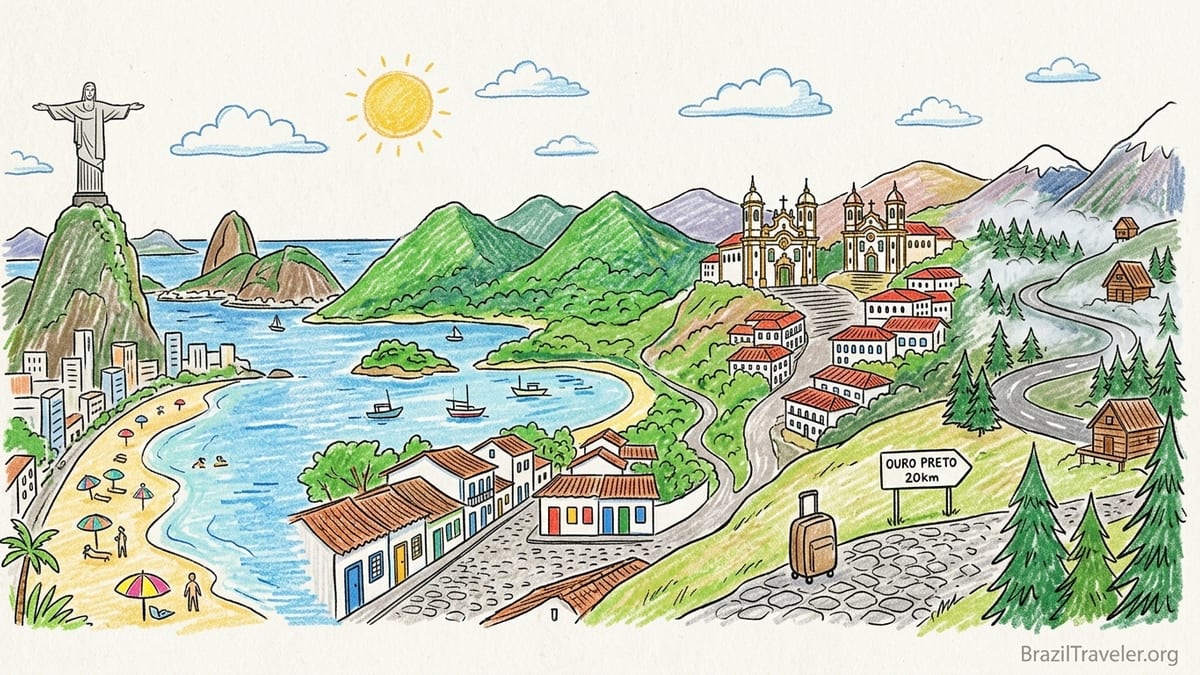
How I Chose My Southeast Brazil Essentials
When I first sketched a route through Southeast Brazil, the obvious anchors were Rio de Janeiro and São Paulo, with Minas Gerais and the Green Coast squeezed in between. On the map it looked simple. On the ground it turned into a series of choices: beaches vs baroque churches, urban nightlife vs mountain hikes, long bus rides vs short flights. Over two extended trips I stayed in Rio, São Paulo, Paraty, Ouro Preto and the Serra da Mantiqueira, and then used current research to fill in the gaps for Ilhabela, Ubatuba, Tiradentes and Pedra Azul in Espírito Santo.
To keep this guide honest, I separate the places I actually slept in from those I only know through research and conversations with local hosts. I will tell you where I dragged a suitcase up a steep cobbled alley in Ouro Preto in afternoon rain, where I tried to find a quiet stretch of sand in Rio on a December weekend, and where I drove mountain roads in thick Mantiqueira fog. For the others, I lean on current information from Brazilian tourism bodies, park authorities and transport operators rather than imagination.
If I were planning your first ten to fourteen days in Southeast Brazil today, I would still begin with Rio or São Paulo, then add at least one colonial town and one nature base. The right mix depends less on raw sightseeing potential and more on the mood you want: Rio and Paraty for sea and scenery, São Paulo and Belo Horizonte for food and culture, Ouro Preto and Tiradentes for history, and Serra da Mantiqueira or Pedra Azul for cool air and hiking.
Rio de Janeiro: Classic First Stop for Beaches and Drama
My first arrival in Rio was one of those cinematic landings, with the plane banking low over Guanabara Bay and the Christ the Redeemer statue appearing through gaps in the clouds. From the airport I headed straight to Ipanema, staying a few blocks behind the beach near Praça General Osório. That area gave me an easy fifteen minute walk to the sand, quick metro access to downtown and Lapa, and enough grocery stores and juice bars to live reasonably cheaply between splurges on seafood and caipirinhas.
Walking was how I understood Rio’s layout. From Ipanema I would cut across to Copacabana along Avenida Atlântica in the morning, when the promenade was full of joggers and beach volleyball players. On weekends the beachfront traffic lanes were closed to cars for several hours, turning the avenue into a wide boulevard for walkers and cyclists. Crowds were heaviest in summer holiday periods around Christmas and Carnival, when a simple beach day meant paying attention to where you put your bag and accepting that the water and kiosks would be full. Midweek shoulder season mornings felt much calmer.
The moment that shifted my view of Rio from beach city to complex mountainside metropolis happened on a van ride up to the Christ the Redeemer statue. Tickets for official vans and the Corcovado train are now sold with timed entry, and recent prices for foreign visitors to the monument and train have been in the range of several dozen US dollars when converted from reais, so booking ahead and choosing the first slots of the morning avoids both queues and intense midday heat. As we climbed through Tijuca Forest, favelas, wealthy neighborhoods and sheer rock faces layered together below. From the viewing platform I could see how beaches, lagoons, tunnels and steep green hills all interlocked, and how small the famous sand crescents looked compared to the city behind them.
On a first trip I would give Rio at least four nights, more if you want day trips to places like Niterói’s contemporary art museum or the wild beaches of Barra de Guaratiba. Rio remains my top choice in Southeast Brazil for iconic scenery, urban hiking and hotel views, and it works well for couples and solo travelers comfortable in big cities. For families, I would look for accommodation in calmer parts of Ipanema or Leblon, avoid carrying valuables to the beach and lean on official taxis or app based rides at night.
São Paulo: Food, Neighborhoods and Urban Culture
São Paulo was not love at first sight. My arrival was a long taxi ride from Guarulhos airport into what felt like endless sprawl, ending at a small guesthouse in Vila Madalena. The neighborhood choice turned out to be everything. Vila Madalena is hilly and leafy, with steep streets, small art galleries and an explosion of casual bars and coffee shops. I could walk safely to restaurants at night, ride the metro from nearby stations to Avenida Paulista or the historic center during the day, and retreat to quieter backstreets when the weekend party scene got loud.
Food is where São Paulo won me over. In one afternoon you can go from an affordable kilo style buffet in the Centro to a Japanese lunch in Liberdade, followed by coffee in a third wave cafe on Rua Augusta and a late pizza in Moema or Bixiga. Many mid range dinners in independent restaurants cost the equivalent of 15 to 25 US dollars per person including a drink, which felt reasonable for the quality. Big name tasting menus in Jardins and Pinheiros easily climb far above that, but you do not need those to understand why Paulistas talk about their city’s gastronomy with such pride.
Crowd levels in São Paulo depend on where you base yourself. Avenida Paulista is packed on Sundays when it is closed to cars and handed over to pedestrians and street performers, while Ibirapuera Park attracts joggers and families every evening. The city’s museums, like MASP on Paulista and the Portuguese Language Museum near Luz station, can be busy on free admission days but are rarely unbearable. What struck me was how much of São Paulo life happens indoors in shopping centers, food courts and cultural institutes, which makes it an all weather choice when the coastal or mountain areas are rainy.
If your main interests are food, nightlife and contemporary culture, São Paulo deserves at least three nights. For a first time visitor combining it with Rio, I would fly into one and out of the other, using a quick domestic flight between them. Compared with Belo Horizonte, which also has a strong food scene but feels more compact and laid back, São Paulo offers more variety and big city energy, at the cost of heavier traffic and longer travel times within the city.
Ouro Preto: The Historic Hill Town That Reframed Minas Gerais
I arrived in Ouro Preto by intercity bus from Belo Horizonte, watching concrete outskirts give way to rolling green hills and sudden church towers. The bus station sits below the historic core, so my first act in town was hauling a wheelie suitcase up a steep cobbled slope toward Praça Tiradentes. I had chosen a simple pousada on a side street near the square so I could walk everywhere, but I learned quickly that “walking distance” in Ouro Preto means accepting serious gradients.
Ouro Preto matters because it concentrates so much of Brazil’s colonial history and baroque art in a single dense valley. The historic town was the first site in Brazil inscribed on the UNESCO World Heritage List in 1980, recognized for its preserved churches, townhouses and urban layout linked to the 18th century gold rush. Brazilian and international heritage bodies highlight the city as one of the country’s leading historic destinations, and municipal tourism figures indicate that several hundred thousand visitors arrive each year. Around that constant flow of students and tourists, everyday life continues, with bakeries, hardware stores and schoolchildren in uniform navigating the same steep streets.
My days in Ouro Preto followed a rhythm of climbing, pausing and entering cool, dim interiors. I would start with a strong coffee and a pão de queijo in a bakery just off Praça Tiradentes, then choose one or two churches to visit in the morning, leaving others for another day so they would not blur together. Admission fees to major churches and small museums were modest, usually the equivalent of a few US dollars, often with separate charges to access gold laden sacristies or small bell towers. Local guides waited near church entrances and the main square, offering short interpretive tours in Portuguese for reasonable set fees or tips, which deepened my understanding of figures like Aleijadinho and the Inconfidência Mineira.
The moment that reshaped my view of Ouro Preto and Minas Gerais came inside the Igreja de São Francisco de Assis. After a busy morning with school groups, there was a short lull. Standing under Aleijadinho’s sculpted facade and Manuel da Costa Ataíde’s intricate ceiling painting, I realized how much wealth and effort had been concentrated in these hills centuries ago, and how this contradicted the idea of the Brazilian interior as historically empty or secondary to the coast. Later, visiting a former gold mine on the edge of town, descending damp tunnels by guided tour, completed that picture with the underground labor that financed the churches’ splendor.
Today, Ouro Preto’s historic center is protected by federal and municipal regulations, and new construction is controlled to preserve views of the church towers and tiled roofs. Road access from Belo Horizonte remains straightforward, with several daily bus departures taking around two to three hours depending on stops. Car access allows side trips to neighboring Mariana or to smaller baroque sites, but parking in the old core is limited and streets are narrow, so I found it easier to explore on foot and by occasional taxi for longer climbs. For a first visit focused on history and atmosphere, I would stay at least three nights, ideally four if you also want to include day trips or slower afternoons in cafes.
Paraty and the Green Coast: Sea Level History and Island Hopping
Paraty is where my idea of Brazilian colonial towns shifted from hillside silhouettes to sea level reflections. I arrived on a hot afternoon by bus from Rio, stepping into the modern station and then walking fifteen minutes to a pousada just outside the car free historic center. Luggage wheels are useless on Paraty’s deliberately uneven stone streets, set to allow seawater to flow in during some high tides, so I carried my bag the last blocks, passing white washed houses with brightly colored doors and windows.
The historic center of Paraty is now part of a UNESCO mixed World Heritage Site created in 2019 that combines the colonial town with surrounding Atlantic Forest and marine protected areas stretching toward Ilha Grande. The protected area covers well over one hundred thousand hectares, and Brazilian and UNESCO documents describe it as a rare cultural landscape where preserved baroque streets meet mangroves, caiçara fishing communities and mountainous rainforest. Walking at dusk, when the stones are slick and the sky turns pink over the bay, you can feel that blend of human and natural history in a way no photo fully captures.
My days in Paraty alternated between water and land. On one day I joined a shared schooner tour from the pier, which stopped at several small bays and beaches reachable only by boat. Crew members grilled simple fish lunches on board, and mask and snorkel rentals were included in a trip that cost roughly the equivalent of 20 to 30 US dollars per person at recent prices. On another day I hired a local van to the trailhead for the Gold Trail, an old stone path through the forest that once linked Minas Gerais to the coast. Walking a section of that trail with a guide pointing out medicinal plants and explaining how enslaved labor carved each step made the connection between Paraty and Ouro Preto tangible.
Crowds in Paraty depended heavily on the calendar. During summer school holidays and major festivals like the international book fair, pousadas in and near the historic center fill up and restaurant waits can stretch. In shoulder seasons, particularly on weekdays, I found a slower rhythm, with locals chatting in doorways and just enough visitors to give the streets life without turning them into a theme park. For couples, Paraty is one of the most atmospheric places in Southeast Brazil, combining romantic colonial architecture with quiet courtyards and boat trips. Families can base themselves near, but not directly in, the old town to have more space and easier car access.
If you are choosing between Paraty and nearby island and surf focused bases like Ilha Grande or Ubatuba, Paraty wins for those who care about architecture and history as much as beaches. I would recommend at least three nights here, more if you want to add kayaking in the bay, visits to local cachaça distilleries or hikes in Serra da Bocaina National Park. Access from both Rio and São Paulo is relatively straightforward via long distance buses and private transfers along the coastal highway, though travel times can lengthen significantly on holiday weekends.
Serra da Mantiqueira: Cool Air, Trails and Mountain Town Atmosphere
After the humidity of Rio and Paraty, arriving in the Serra da Mantiqueira felt like switching countries. I first based myself near Campos do Jordão, one of the highest cities in Brazil at more than 1,600 meters above sea level, reached by a winding road from the Paraíba Valley. My pousada sat on a hillside on the edge of town, with morning mist in the pines and distant views of chalet roofs. This was a place where you needed a jacket at night even when the lowlands were hot.
The Serra da Mantiqueira is a long mountain range shared by São Paulo, Minas Gerais and Rio de Janeiro states, known for its remnants of araucaria forest, cool climate resorts and a growing network of hiking trails. Campos do Jordão itself has an alpine themed center with fondue restaurants and chocolate shops, which can be crowded and heavily commercial on winter weekends and holidays. What interested me more were the surrounding protected areas and trails, particularly in the state park and environmental protection area that preserve native forest and water sources. Well marked walks like short waterfall trails and longer paths along rivers give you options from easy family outings to more demanding day hikes.
On a subsequent visit I stayed in Monte Verde, a smaller mountain village in Minas Gerais at around 1,500 meters of altitude. Here, the feel was more compact, with a single main street of bakeries, restaurants and gear shops, and a set of trailheads leading up to rocky viewpoints along the ridge. One hike to a peak known locally for its wide views took several hours out and back, with a modest entrance fee at a private gate and basic infrastructure like simple parking and snack stalls. Recent local guides describe flagship routes such as Pedra Partida, where you walk the ridge of the Mantiqueira with sweeping valley vistas on clear days, though fog and rain can roll in quickly, so I learned to start early.
For me, the Serra da Mantiqueira became the ideal counterpoint to the coast. It is where I would send couples who like fireplaces and short hikes, families looking for fresh air and easy access viewpoints, and city residents wanting a weekend break without long flights. Compared with Espirito Santo’s Pedra Azul region, which I have only researched, the Mantiqueira offers more clustered mountain towns within a few hours’ drive of São Paulo, with a wider range of pousadas from simple cabins to high end spas. I would allocate at least three nights here on a two week trip, splitting time between one larger town like Campos do Jordão and a smaller base like Monte Verde if you enjoy variety.
Researched Alternatives: Ilhabela, Ubatuba, Tiradentes and Pedra Azul
Some Southeast Brazil names kept coming up in conversations with Brazilians and in current destination reports, even though I did not manage to visit them in person. Ilhabela and Ubatuba, both in the coastal area between São Paulo and Rio, emerged as strong alternatives or complements to Paraty for beach focused travelers. Ilhabela is a large island reached by car ferry from São Sebastião, known for its combination of developed beaches, waterfalls and maritime protected areas. Recent park and tourism information notes trail systems within a state park that covers most of the island, with access controlled for vehicle numbers on certain days to protect the environment.
Ubatuba, on the mainland, has a long string of beaches ranging from accessible town stretches to more preserved coves within conservation units. Brazilian travel coverage highlights it as one of the country’s surf capitals, and also notes frequent rainfall due to its position against the coastal mountains. For a first trip, I would treat Ilhabela and Ubatuba as specialized add ons: excellent if you want multiple beach days, surfing and waterfall hikes, but less compelling if you have limited time and already plan to visit Paraty or Ilha Grande.
Tiradentes, in Minas Gerais, is another researched but not yet firsthand town that often appears in discussions of colonial Brazil. Compared with Ouro Preto, it is described as smaller, flatter and more polished, with a strong focus on gastronomy and boutique accommodation. Many Brazilian travelers pair Tiradentes with nearby São João del Rei on road trips, taking advantage of restored churches and a short tourist train line. If your priority is leisurely food and design focused pousadas in a historic setting, I could imagine two relaxed nights in Tiradentes complementing three more intense days in Ouro Preto.
Pedra Azul and the mountains inland from Vitória, capital of Espírito Santo state, form another cluster that caught my attention during research. The Pedra Azul State Park protects striking granite rock formations colored by lichens, set amid rural landscapes and cooler climate farm stays. Official environment agency information explains that the area was first protected in the 1960s and that access today is through guided visits on marked trails, with daily visitor limits and mandatory advance booking in high season to minimize impact. For hikers and photographers willing to fly into Vitória and drive inland for a few hours, this could be an appealing alternative to the Serra da Mantiqueira with fewer international visitors.
How I Would Allocate Nights and Match Destinations to Interests
Looking back with the benefit of both experience and up to date research, my ideal first timer route through Southeast Brazil runs ten to fourteen nights and balances coast, city, history and mountains. One realistic version for a two week trip without domestic flights would be three or four nights in Rio de Janeiro, bus along the coast to Paraty for three nights, then inland by bus or private transfer to São Paulo for three nights, finishing with three nights in the Serra da Mantiqueira before returning to São Paulo for departure. This keeps travel legs between four and six hours and avoids backtracking.
If you are more interested in baroque churches and Brazilian independence era history than beaches, I would shift the emphasis toward Minas Gerais: start with three nights in Belo Horizonte for its markets and museums, add three or four nights in Ouro Preto, then consider a side trip of two nights to Tiradentes if you have access to a car. From there, you could still reach Rio or São Paulo by bus or a combination of bus and flight, though total overland travel times grow longer and require more planning.
For couples looking for romance and scenery, my strongest combination is Rio, Paraty and the Serra da Mantiqueira. Rio provides dramatic viewpoints and nightlife, Paraty offers cobbled streets and boat days, and the Mantiqueira gives you fireplaces and forest walks. Families with school age children might prefer to base themselves longer in one or two places with good infrastructure, such as Rio and Campos do Jordão or São Paulo and Ubatuba, to reduce packing and unpacking. Food travelers and night owls, meanwhile, should prioritize São Paulo and Belo Horizonte, with side trips from each rather than constant moves.
Whatever mix you choose, transport in Southeast Brazil is a blend of reliable long distance buses, steadily improving domestic flight networks and, in mountain and rural areas, the flexibility of rental cars or private drivers. For heavily visited sites like the Christ the Redeemer statue in Rio, the historic center of Ouro Preto and the Paraty old town, up to date information from official operators and local tourism offices on ticketing, opening hours and access rules is crucial, since these details are adjusted periodically in response to visitor numbers and events.
FAQ
Q1. How many days do I need for a first trip to Southeast Brazil?
For a balanced first trip that includes a major city, a historic town and some nature, plan on at least ten days. Two weeks lets you comfortably combine Rio or São Paulo with Paraty, Ouro Preto or another colonial town and a mountain area such as the Serra da Mantiqueira.
Q2. Is Rio de Janeiro or São Paulo better as a starting point?
Rio is stronger for iconic scenery, beaches and quick access to coastal towns like Paraty, so it suits first time visitors focused on landscapes. São Paulo works better if your priorities are food, nightlife and museums, or if you want easier access to the Serra da Mantiqueira and interior of São Paulo and Minas Gerais.
Q3. How safe did you feel traveling in these destinations?
I treated Rio and São Paulo like other large cities, avoiding quiet streets at night, using app based taxis after dark and keeping valuables minimal in crowded areas. In Paraty, Ouro Preto and the Serra da Mantiqueira I felt more relaxed walking in the evening, but still used basic precautions such as not flashing expensive cameras or phones.
Q4. Do I need to rent a car to visit places like Ouro Preto and Paraty?
No. I visited both primarily by long distance bus and local taxis or walking. A car gives more flexibility for side trips to smaller beaches or nearby towns, and is useful in mountain regions like Campos do Jordão or Monte Verde, but it is not essential for the core historic centers.
Q5. When is the best time of year to visit Southeast Brazil?
The cooler, drier months from May to September are generally comfortable for cities, colonial towns and mountain areas, with sunny days and milder nights. Coastal areas like Rio, Paraty, Ilhabela and Ubatuba are warmer and more humid year round, with heavier rains and fuller crowds around the Southern Hemisphere summer from December to February.
Q6. How expensive are attractions such as Christ the Redeemer and historic churches?
Major attractions like Christ the Redeemer, reached by official vans or train, usually cost the equivalent of several dozen US dollars per adult with transport and monument access. Entry to individual churches and small museums in towns like Ouro Preto typically costs only a few US dollars in local currency, with optional guided tours available for similar amounts.
Q7. Which destinations are best for families with children?
For families, I recommend Rio or São Paulo for big city parks and attractions, paired with Paraty or Ubatuba for calmer beaches and boat trips, and Campos do Jordão or Monte Verde in the Serra da Mantiqueira for easy hiking and cooler temperatures. Choosing just two or three bases and staying several nights in each helps keep travel days manageable.
Q8. Are there good hiking options near the main cities?
Yes. Near Rio you have trails in Tijuca National Park and coastal hikes beyond the main beaches. From São Paulo, the Serra da Mantiqueira offers many marked trails around Campos do Jordão and Monte Verde, while Espirito Santo’s Pedra Azul region, accessible from Vitória by car, has guided routes in a scenic state park.
Q9. How important is it to include a colonial town like Ouro Preto or Paraty?
Including at least one colonial town adds a historical dimension you cannot get from beaches and big cities alone. Ouro Preto emphasizes baroque churches and gold rush history in a dramatic hill setting, while Paraty combines a preserved historic center at sea level with access to islands, rainforest and traditional coastal communities.
Q10. Can I visit all the main places in one trip?
It is technically possible to link Rio, São Paulo, Paraty, Ouro Preto, Tiradentes and a mountain area in a single long itinerary, but you risk spending too much time in transit. Most travelers enjoy Southeast Brazil more by choosing three or four key bases and leaving others, such as Ilhabela, Ubatuba or Pedra Azul, for a future visit.