


Booking a mountain hotel or pousada in Southeast Brazil in 2026 is no longer about finding “a place with a fireplace.” The Serra da Mantiqueira and the capixaba highlands are now packed with thousands of chalets and boutique pousadas touting hydromassage tubs, panoramic decks and ever more dramatic couple-focused photos. After several cool-season trips through Campos do Jordão, Monte Verde, Santo Antônio do Pinhal, São Bento do Sapucaí, Gonçalves and Pedra Azul / Domingos Martins, what stayed with me was not the brochure language, but the very physical feeling of each stay: the actual room temperature at night, how the mattress felt when the wind picked up, whether the fireplace really heated the space, and how far I had to walk in the fog for a late dinner.
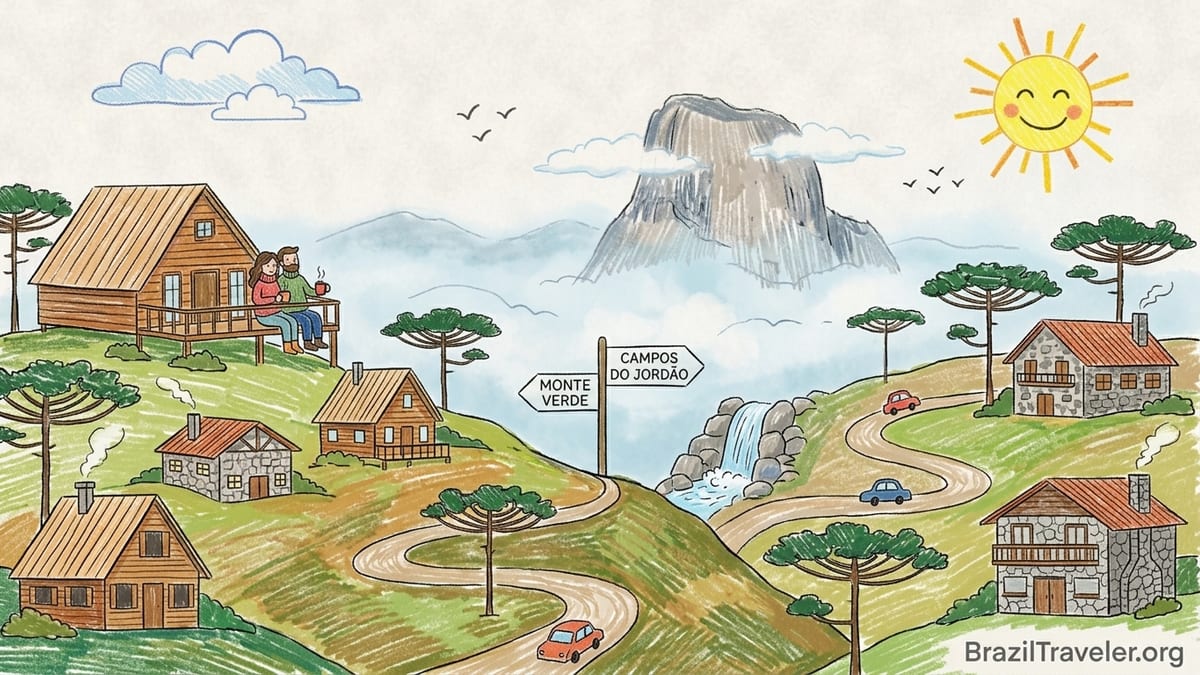
Serra da Mantiqueira in 2026: A Cooler-Weather Boom
Across the Serra da Mantiqueira today, Booking and similar platforms surface several thousand places to stay, from basic chalets in dirt-road valleys to all-suite romantic pousadas with spa-level amenities. That scale matters when you are choosing a cool-weather stay because it means almost every town now offers both central, walkable options near restaurants and more isolated chalets in the forest. On my most recent winter circuits in 2024 and 2025, average nighttime lows around 5 to 8 degrees Celsius in July were common in Campos do Jordão and Monte Verde, and drops close to freezing were not unusual at higher, exposed pousadas.
Demand has clearly shifted toward couple-focused experiences. In Campos do Jordão and Monte Verde, recent search trends and local tourism coverage emphasize “pousadas românticas” with in-room hydromassage, private decks and breakfast served in the room, often with only a handful of units per property. Instead of traditional hotel corridors, you now see independent chalets sprinkled up the hillsides, each promising the feeling of a private mountain cabin, often with parking right beside the unit so guests can arrive late at night without crossing a cold garden.
That new inventory does not feel the same everywhere. Campos do Jordão tends to split between upscale pousadas walking distance from Capivari’s restaurants and quieter properties set a short drive away in neighborhoods like Vila Inglesa or the Vale da Mantiqueira. Monte Verde leans into its “Suíça mineira” image, with chalets on wooded slopes and an intense focus on fireplaces and bathtubs. Smaller hubs like Santo Antônio do Pinhal, São Bento do Sapucaí and Gonçalves still feel rural, with more earth roads and fewer units, which changes not only how you move around, but how the mountain nights sound from your balcony.
On the capixaba side, Pedra Azul and Domingos Martins have fewer properties overall but punch above their weight in romantic demand. The highland climate and the presence of the Pedra Azul State Park create an environment where a morning can start in mist that hides the rock wall and end in a clear afternoon warm enough for a pool before another sharp temperature drop at night. The result is a region where cool-weather stays are about contrasts: hot baths and cold air, crackling fireplaces and quiet, foggy roads.
Campos do Jordão: Romance Between Capivari and the Valleys
Campos do Jordão is where I first felt the difference between staying in the heart of the action and retreating into the valleys. When I stayed at a pousada a short walk from Capivari, the room itself was warm enough that I almost forgot I was in the mountains. Central properties often rely on gas or oil heaters in addition to fireplaces, and even on a 4 degree Celsius July night the interior hovered around 20 degrees with the heater humming. Windows are more sealed than in older chalets, so drafts are minimal, and heavier duvets or down quilts are standard rather than a luxury add-on.
At a more secluded property like Pousada Chalés da Mantiqueira, which spreads a small “village” of 14 units along a 5,200 square meter hillside in the Vale da Mantiqueira, the atmosphere is different. My chalet there had an in-room hydromassage tub and a fireplace near the bed, with views across the valley rather than toward town. Nights cooled quickly once the sun dropped behind the ridge, and without the constant low-level heat of urban buildings, the temperature inside the chalet dropped into the mid-teens Celsius within an hour if the fireplace was off. Once lit, the fireplace did more than decorate. After 30 to 40 minutes, the entire wooden interior warmed and held heat long enough for a post-dinner bath without shivering when getting out of the water.
Breakfast in these valley pousadas is part of the experience. At Chalés da Mantiqueira, morning began with a spread of breads, seasonal fruit, cheese and cakes served in a glassed-in common room with views over the araucaria forest, often still wreathed in lingering fog. Driving back to Capivari for lunch took around 10 to 20 minutes depending on traffic. For me, that balance worked: I could spend afternoons in the bustle of Capivari, but return to a quieter, better-insulated room without the bar noise and car horns that sometimes reach central hotels until late night during winter festivals.
In Campos do Jordão, I preferred staying slightly away from Capivari rather than in complete isolation. The weather and crowd patterns explain why. Fog often slides into the valley from mid-evening in the colder months. On one July stay, visibility on a minor road dropped to a couple of car lengths around 20:00, and I was grateful my pousada sat on a relatively straight stretch close to the main road rather than at the end of a steep earth lane. Having parking at room level, which many chalets offer, made it easier to unload luggage without standing in the cold for long. For couples who want the photographs and the vibe seen on booking pages, Campos can deliver, but the most convincing romantic atmosphere tends to be in these valley or neighborhood pousadas, where the night sky is darker and the silence more complete than in Capivari itself.
Monte Verde: Fireplaces, Hydros and the Choice Between Town and Woods
Monte Verde in winter can feel colder than Campos do Jordão because of its winds and orientation, even when the thermometer shows similar numbers. Local tourism material and recent accolades refer to it as a prime winter and romance destination, and weekend visitors from São Paulo and Belo Horizonte treat it as a place where the fireplace is non-negotiable. On one June visit, the temperature at 22:00 was around 3 degrees Celsius at a pousada above the main avenue, and the difference between a room with an effective heating system and one with only decorative features was immediately apparent.
My most memorable night was at Pousada Chalé da Floresta, which puts a strong focus on couples. The chalet I stayed in had a fireplace directly at the foot of the bed, which meant the radiant heat reached where I actually wanted it rather than dissipating in a corner of a big living room. Once lit, the stone structure noticeably warmed the room after about half an hour, and with the windows closed and heavy curtains drawn, the interior temperature climbed into the low twenties. The hydromassage tub was in the same heated environment, so using it on a cold, drizzly evening did not mean sprinting from hot water into freezing air.
During another trip I tried a pousada closer to the main avenue, similar in feeling to the Suíça Mineira properties that offer a mix of chalets and suites near town. There, I could walk to restaurants that serve fondue, trout and mountain-style dishes without moving the car. The trade-off was clear: while the room offered a small fireplace and an electric heater, thin walls meant I heard late arrivals in neighboring units and music from a nearby bar until close to midnight. Fog also settled heavily along the main road, but the urban lighting minimized the sense of isolation and made it easier to return from dinner on foot.
In Monte Verde, I found that if your main goal is to linger in the bathtub and fireplace with short breaks for food, staying within walking distance of the center works well. Stays set deeper in the woods, on secondary roads beyond the portal, really come into their own for travelers who plan to stay in, cook some meals in the chalet kitchen and enjoy the quiet. In those more remote chalets, parking is usually right outside the door, but steep driveways can become slippery in prolonged drizzle, and it pays to arrive before dark if you are not used to mountain roads.
Santo Antônio do Pinhal and São Bento do Sapucaí: Between Town Comfort and Forest Isolation
Compared with Campos do Jordão and Monte Verde, Santo Antônio do Pinhal and São Bento do Sapucaí feel almost like secret annexes of the Mantiqueira. They are close enough to visit Campos for the day, yet their own lodging scene prioritizes quieter nights and views toward the Serra and the Pedra do Baú massif. On recent stays, winter nights in both towns dipped to around 6 to 9 degrees Celsius, with stronger cooling at pousadas higher up the slopes or exposed to wind funnels.
In Santo Antônio do Pinhal, I split my time between a central pousada and chalets further out. At Pousada Venezia, which sits essentially in the heart of town, my ground-floor room had a simple layout with a double bed, an extra single, TV, minibar and a small fireplace. There was no elaborate spa bathroom here, but the comfort came from practicality. The masonry construction held warmth reasonably well, and with a light heater and the fireplace running for an hour or so, the room stabilized at a cozy temperature. I could step out and be at a café or restaurant within minutes without needing the car, and even late at night the streets retained a sense of safety and small-town calm.
For a more cinematic mountain stay, I moved to a chalet complex outside town. One of the more atmospheric examples in the region is Pousada Alpes, where eight individual alpine-style chalets for couples sit in a garden with living fences, each with veranda and hammock. The chalet I stayed in had a queen bed, gas-heated shower, minibar and a wood-burning fireplace. Nights there felt measurably colder than in the center. Without the fireplace, the wooden structure cooled sharply after sunset, and the temperature inside could slip below 15 degrees Celsius on especially clear nights. Lighting the fireplace transformed the space within 40 minutes, and the combination of thick blankets and a still-warm interior made for some of the best sleep I had in the region.
Another style of stay appears at Reserva Santo Antônio, where one cabin faces the Pedra do Baú and others retreat deeper into the forest. The Pedra do Baú cabin combines a deck with mountain views, queen bed, gas water heating, fireplace, kitchen corner and hydromassage tub, while a “Cabana da Mata” sits about 50 meters from the parking area, reachable by stairs, enveloped in trees. There, with lareira, a separate level for hydro and sauna, and a mezzanine bedroom, the sense of isolation is deliberate. At night, the only sounds I heard were wind in the leaves and distant water, and fog sometimes washed through in waves, briefly hiding the trees just beyond the deck. Returning to town for dinner meant a drive, so I stocked up on supplies beforehand and cooked simple meals in the kitchenette, which made sense given the distance and the steep access.
São Bento do Sapucaí leans even more into the rural. Stays around the Pedra do Baú complex are often accessed via earth roads that can become muddy after rain. At properties like Pousada do Quilombo, where suites and chalets face directly toward the rock walls, evenings were about watching the last light fade from the stone and then retreating into a room with heavier bedding and, in some units, bathtubs. Because these pousadas sit several kilometers from the small town center, walking to restaurants is rarely practical at night, so guests either drive back along dark, twisting roads or dine at onsite restaurants. The benefit is a quiet that no central hotel can match and a sky dark enough to see the Milky Way in clearer winter spells.
Gonçalves: Zilhões of Pousadas and Genuine Mountain Chill
Gonçalves, in Minas Gerais, does not have the volume of Campos do Jordão, but among mountain travelers it is frequently cited as a favorite precisely because it feels like a mosaic of scattered chalets. People often describe it as having “zilhões de pousadas,” and arriving there, you quickly understand the exaggeration. Chalets and small lodges perch on ridges, hide in valleys and dot slopes accessed by narrow dirt roads. Nighttime temperatures here, particularly near the higher lookouts, often flirt with freezing in winter, and the combination of altitude and open exposure makes windchill a real factor.
My first stay, in a cabin above one of the valleys, reminded me why solid bedding matters more than decor details. The wooden chalet came with a double bed, a standard electric heater and a small fireplace in the corner. The mattress was firm and covered with a thick blanket and down-style duvet. On a July night when ice formed on the car windshield before dawn, the interior of the chalet, with both heater and fireplace running, stayed in the mid-teens Celsius, which felt comfortable once under the covers but brisk when stepping out of bed. Fog rolled in and out throughout the night, sometimes thick enough that I could not see beyond the veranda railing. With parking next to the chalet and no nearby restaurants, I accepted that staying here meant preparing easy dinners in the small kitchen and leaning into the solitude.
A later visit to a slightly lower-elevation pousada closer to the paved access road presented a different balance. Here, the room had a larger bathroom with a jetted tub, more robust gas heating for the shower and a fireplace that was clearly sized with the room volume in mind. Staff left pre-cut wood and kindling, and the masonry walls retained the heat sufficiently that by the time I finished dinner in town and drove back, the space was still warm. In Gonçalves, distance to town is crucial. Many of the most photogenic chalets are 15 to 30 minutes from the small center by winding, partially unpaved roads. Returning after a wine-heavy dinner would not be wise, so either choose a place with its own restaurant or plan simple in-room meals.
What stood out in Gonçalves compared with Campos or Monte Verde was the silence and darkness. There were no lines for fondue or crowded winter festivals, just the sound of crickets and occasionally distant dogs. The romantic atmosphere here does not come from scripted decor but from the real sense of being in the mountains. Booking photos often show perfectly lit decks and cottony mist, and in this case, reality matched the imagery: I woke to a valley filled with clouds below the veranda more than once, and the chill on my face when I stepped out matched what I had hoped for when I booked.
Pedra Azul and Domingos Martins: Capixaba Highlands With Spa-Level Comfort
Shifting east to Espírito Santo, the mountains of Pedra Azul and Domingos Martins deliver a different cool-weather profile. The climate here is milder than the coldest corners of the Mantiqueira, but it is still distinctly fresh compared with the coast. Domingos Martins sits about 100 kilometers from Vitória, and the Pedra Azul region has been promoted for having one of the more pleasant climates in the world. Daytime temperatures during my stays often reached the low twenties Celsius even in winter, yet nights dropped enough that fireplaces and warm bedding felt welcome.
At Pousada Pedra Azul, located along the scenic Rota do Lagarto and very close to the Pedra Azul rock formation itself, my room had views directly toward the stone face. The accommodation combined the structure of a small hotel with the atmosphere of a mountain inn. My suite offered a comfortable bed with heavy covers, a heater and a balcony that caught cool breezes in the late afternoon. When fog rose from the forest after dark, the rock occasionally vanished from sight, replaced by a white wall beyond the balcony railing. Inside, with the heater on, the room settled at around 21 degrees Celsius, and I never felt the need to wear more than a light sweater indoors.
For a more intensely romantic setup, I tried Pousada Lusitânia, also in Pedra Azul, which offers units with warm-and-cold air conditioning, fireplaces and hydromassage bathtubs. Here, the atmosphere leaned closer to a boutique spa hotel. My chalet had a wooden interior, large bed with white linens, a tub in the bathroom and a small seating area near the fireplace. Lighting the lareira was less about survival and more about mood, since the climate was relatively gentle, but with the combination of air conditioning set to warm and the fire burning, the entire space felt enveloping. After dinner at a nearby restaurant along the Rota do Lagarto, I returned to find the fog had thickened so much that car headlights lit only a narrow corridor ahead, emphasizing just how quiet the area becomes after day visitors depart.
In the capixaba highlands, I found I preferred staying along or near the Rota do Lagarto rather than deep in isolated roads. That location meant I could reach trailheads, farm cafés and restaurants within a short drive, and in some cases on foot, without navigating unlit, narrow lanes late at night. Parking was usually straightforward, either in front of the chalets or in a small lot, and staff were used to guests arriving from the coast after work on Friday evenings. The mix of crisp morning air, mid-day warmth suitable for poolside lounging and then cool nights made it possible to enjoy both hydromassage tubs and outdoor decks within the same day.
What the Photos Do Not Show: Temperatures, Access and Practical Comforts
Browsing mountain hotels and pousadas online in 2026, especially in Campos do Jordão and Monte Verde, you will see an endless flow of similar photographs: champagne by a tub, rose petals on a bed, fog between pines. My repeated trips have shown that the difference between a truly satisfying stay and a disappointing one lies in details that photos rarely convey. The first is the combination of insulation and heating. A large stone fireplace in a poorly sealed room might make for a great picture but will struggle to keep temperatures comfortable when the thermometer drops near zero. Conversely, a compact room with good windows and a modest heater can feel genuinely cozy even with only a small lareira for ambience.
Another often-overlooked factor is road access. Many chalets marketed as “exclusive” sit at the end of steep dirt tracks. In Gonçalves and São Bento do Sapucaí, I drove stretches where heavy rain carved ruts into the surface and fog reduced visibility to a few meters. Arriving in daylight and driving slowly was essential, and for anyone not confident on such roads, choosing a pousada closer to the main paved routes, like those near the centers of Santo Antônio do Pinhal or Monte Verde, can be more relaxing. Parking matters as well. At properties where I could park directly beside the chalet, unloading luggage in the cold took only a couple of minutes. In others, where parking was central and units were accessed via garden paths or stairs, the walk felt much longer at 7 degrees Celsius with mist in the air.
Distances to restaurants shape the evening experience. In Campos do Jordão and Monte Verde, staying within walking distance of Capivari or the main avenue means you can enjoy wine or craft beer with dinner and stroll back to your room. The drawback is higher noise levels and, in peak months, a more manufactured-feeling alpine atmosphere than some travelers seek. In outlying areas, such as the valleys of Campos, the forested slopes of Monte Verde beyond the portal or the countryside of São Bento do Sapucaí, the stars feel closer and nights far quieter, but you need to think through dinner logistics. Some pousadas have onsite restaurants or offer room service-style dinners; others expect guests to self-cater or drive back into town.
Finally, there is the question of whether the romantic atmosphere lives up to booking photos. In my stays, the places that felt genuinely romantic were not always the most expensive or the most elaborately staged. A simple chalet at Pousada Alpes, with its small veranda and hammock, felt more authentic than a central hotel room with synthetic decor. In Pedra Azul, Pousada Lusitânia’s combination of real comfort, views and attention to small gestures, like leaving extra blankets and stocking the fireplace before sunset, made the stay feel cared-for rather than just photographed. In Campos, a valley-facing chalet at Chalés da Mantiqueira captured more of the mountain mood than some flashy but noisy central suites.
The Takeaway
Mountain hotels and pousadas in Southeast Brazil have evolved rapidly, and by 2026 the cool-weather inventory across the Serra da Mantiqueira and the capixaba highlands is deeper and more diverse than ever. Booking engines now list thousands of options, but filters and star ratings tell only part of the story. What matters most when you are actually inside the room at 23:00 on a foggy July night is far more concrete: how effective the heating is, how insulated the windows are, whether your car is parked steps away instead of at the bottom of a dark, slippery driveway, and how far you are from the nearest warm meal.
In Campos do Jordão and Monte Verde, I gravitated toward stays slightly removed from the busiest blocks but not entirely isolated, which offered mountain views and quieter nights without adding long night drives to every dinner plan. In Santo Antônio do Pinhal, São Bento do Sapucaí and Gonçalves, I embraced isolation more fully, choosing chalets with fireplaces, decks and hydromassage tubs where staying in was the whole point and driving into town was an occasional outing. In Pedra Azul and Domingos Martins, I picked properties near the Rota do Lagarto, where the blend of easy access, views of the Pedra Azul and spa-like amenities created a gentler, but still distinct, mountain experience.
If you remember that these are real mountains with real weather, not just photographic backdrops, you will choose better. Look closely at heating, access, parking and distance to restaurants, read recent traveler comments about nighttime temperatures and fog, and decide whether you want to be able to walk to dinner or to hear only the wind in the pines at night. Do that, and the next time you step out onto a chilly veranda in Campos, Monte Verde, the Mantiqueira backroads or Pedra Azul, the reality of your stay is far more likely to match the promise of your booking screen.
FAQ
Q1. In which town did you feel the cold most inside the room?
In my experience, the coldest-feeling interiors were in higher, more exposed chalets in Gonçalves and São Bento do Sapucaí, especially in wooden cabins without strong auxiliary heating.
Q2. Where did the fireplace actually heat the room well, not just decorate it?
The fireplaces that heated best were at Pousada Chalé da Floresta in Monte Verde, in a chalet at Pousada Alpes in Santo Antônio do Pinhal and in a valley chalet at Pousada Chalés da Mantiqueira near Campos do Jordão, where room size and insulation matched the fireplace capacity.
Q3. If I want to walk to restaurants at night, which areas should I prioritize?
Choose accommodations near Capivari in Campos do Jordão, along the main avenue in Monte Verde, or in the center of Santo Antônio do Pinhal or Domingos Martins, where most bars and restaurants are within a short walk.
Q4. Where is isolation part of the charm rather than a drawback?
Isolation is a clear asset in cabins at Reserva Santo Antônio and rural chalets near São Bento do Sapucaí and Gonçalves, as well as some hillside pousadas in Monte Verde and valley lodges in Campos do Jordão.
Q5. How foggy do the roads really get at night in winter?
On several July and August nights, fog on rural Mantiqueira roads reduced visibility to only a few car lengths, particularly on routes around Campos do Jordão, São Bento do Sapucaí and Gonçalves, making slow, cautious driving essential.
Q6. Which destinations felt most romantic in practice, not just in photos?
The stays that felt most genuinely romantic were forest-facing chalets around Santo Antônio do Pinhal and São Bento do Sapucaí, carefully run pousadas in Monte Verde’s wooded slopes, and spa-style chalets facing Pedra Azul in Domingos Martins.
Q7. Are hydromassage tubs really usable on the coldest nights?
Yes, provided the room has solid heating or the tub sits in the same warm environment as the fireplace. I comfortably used hydromassage tubs in Campos do Jordão, Monte Verde, Santo Antônio do Pinhal and Pedra Azul on nights close to 5 degrees Celsius outside.
Q8. Where did staying near town feel clearly better than being isolated?
In Campos do Jordão and Monte Verde, I preferred being a short drive or walk from the main restaurant areas, because winter traffic and fog made long nighttime drives from very remote chalets less appealing after dinner.
Q9. Where did the booking photos match the real atmosphere most closely?
Photos and reality aligned best at properties with clear mountain views and limited visual clutter, such as valley-view chalets near Campos do Jordão, forest cabins by Santo Antônio do Pinhal and Pedra Azul pousadas directly facing the granite wall.
Q10. How far in advance should I book for peak winter weekends?
For July and major holiday weekends, it is wise to book at least two to three months ahead in Campos do Jordão and Monte Verde, and about one to two months ahead in Santo Antônio do Pinhal, São Bento do Sapucaí, Gonçalves and Pedra Azul.