

I’ve learned to plan Brazil the way Brazilians plan weekends: by choosing a mood, not a checklist. One trip can be samba and sea spray, another can be food and museums, another can be sunrise on a river with nothing but bird calls and engine hum. In this guide, I’m not going to rank Brazil like it’s a contest. I’m going to tell you which destinations stayed with me, which ones I’d return to, and which ones I’m still saving for the right season and the right travel partner. I’ll also be transparent about what I actually visited: I’ve been to Rio de Janeiro, São Paulo, Salvador, Foz do Iguaçu, Florianópolis, and the Lençóis Maranhenses region. The Amazon (via Manaus), the Pantanal, and Fernando de Noronha are the three I’ve researched deeply and would book differently now, because logistics, reservations, and seasonality can make or break them.
Before you book: the Brazil logistics that shape everything
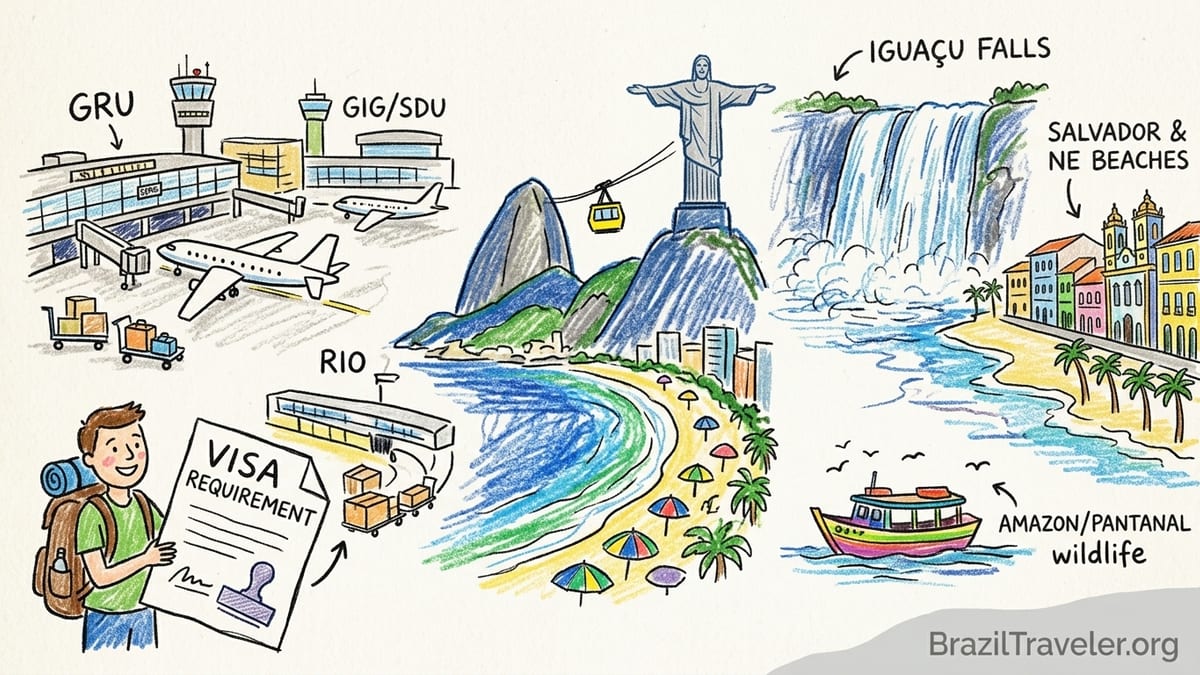
If you’re a U.S. citizen planning Brazil now, treat the visa requirement as step one, not a footnote. Brazil reinstated a visa requirement for U.S. travelers in April 2025, and official U.S. government travel guidance still reflects that requirement. Build time for paperwork before you buy nonrefundable flights.
Once you’re in Brazil, the biggest planning win is understanding airports and what they’re good for. São Paulo’s Guarulhos (GRU) is the international workhorse, and Rio’s Galeão (GIG) is the easiest international gateway for Rio. For domestic hops, you’ll hear locals talk about Rio’s Santos Dumont (SDU) and São Paulo’s Congonhas (CGH) like they’re subway stops, but both operate under capacity constraints. In practice, that means popular routes like the Rio–São Paulo air bridge can be frequent but also price-spiky, and last-minute changes ripple faster than you’d expect.
Finally, accept that Brazil is a country of seasons that don’t align neatly with your calendar assumptions. The Northeast beach belt has a different rainfall rhythm than Rio. The Amazon’s experiences shift with river levels. The Pantanal is fundamentally defined by wet and dry cycles. If you pick the right destination for the month you’re traveling, Brazil feels effortless. If you fight the seasonality, you’ll spend more time rearranging tours than enjoying them.
Rio de Janeiro (visited): where the city hits you all at once
I arrived in Rio with the classic picture in my head: Sugarloaf, Copacabana, and that impossible curve of mountains meeting water. What surprised me was how quickly Rio becomes neighborhood-specific. I stayed in the Zona Sul in the Ipanema and Copacabana orbit, because it’s walkable, beach-forward, and you can get a lot done without spending your whole trip inside a car. The first hour felt like sensory overload: surf noise, beach vendors calling out, workout groups on the promenade, and the kind of golden light that makes even a simple kiosk lunch feel cinematic.
Transport in Rio is easiest when you mix methods. For beach neighborhoods, I walked almost everywhere. For longer hops, I used app-based rides and the metro where it made sense, especially when I wanted to avoid traffic around peak beach time. My best advice for a first-timer is to plan one major “view” experience early in your trip, because it calibrates everything else. When I went up for a panoramic lookout, it didn’t just give me photos, it gave me a mental map. Suddenly, neighborhoods had context and distances made sense.
Food in Rio is where you can keep it simple and still eat well. One night I kept it casual with a classic Brazilian plate: grilled meat, rice, beans, farofa, and something cold and citrusy to drink when the humidity wouldn’t let go. Another day, I did the Rio thing and let the beach guide my choices: a quick bite near the sand, then a proper sit-down dinner later, timed for when the air cools and the city feels less frantic.
If I were planning Rio now, I’d stay at least four full days, and ideally five if it’s your first Brazil trip. Rio suits culture travelers who still want beaches, photographers who care about light, and anyone who wants that “only-in-Brazil” energy without leaving a major city. If you’re returning to Brazil, Rio becomes even better when you stop trying to do everything and give one day to simply living there: morning beach, long lunch, late afternoon viewpoint, and an evening that doesn’t revolve around ticking attractions off a list.
São Paulo (visited): Brazil’s best food city, and the place that makes you extend your trip
São Paulo doesn’t seduce you with scenery; it wins you over with depth. I arrived expecting a quick stopover and ended up wishing I’d built more time into the city. The arrival felt like a shift in tempo: less beach breeze, more big-city rhythm, with neighborhoods that have distinct identities and an endless supply of places to eat well even on a random weeknight.
I based myself in a central, well-connected area where I could move between museums, parks, and restaurants without turning every outing into a cross-town expedition. São Paulo is where you plan by neighborhood clusters. Do one area at a time and you’ll feel efficient; try to zigzag and you’ll spend your best hours in traffic.
Gastronomy is the reason to be here. The best real-world example I can give is how easy it is to build a food day that ranges from simple to spectacular: start with coffee and a pastry that’s better than it has any right to be, do a lunch that introduces you to Brazilian comfort staples, and then go for a dinner that could hold its own in any global city. If you like markets, São Paulo also rewards the traveler who wants to taste and browse rather than commit to formal meals all day.
How long would I stay now? Three full days minimum, four if you’re a museum or restaurant person. São Paulo is perfect for repeat trips to Brazil because it gives you new neighborhoods and new meals every time. It’s also a smart first-trip add-on if you’re flying in and out of GRU and want to pair city life with nature, because it connects well to domestic flights and long-distance buses.
Salvador (visited): Afro-Brazilian culture, sea air, and the city’s magnetic old quarter
Salvador was the place where Brazil’s cultural layers felt the most immediate to me. I arrived to heat that wraps around you and a coastline that keeps peeking through the city’s streets. The historic center, especially around the Pelourinho area, is the kind of place where you look up as much as you look forward: colorful facades, churches, steep streets, and music that seems to drift from courtyards and doorways.
I stayed in an area that made it easy to split my days between history and the waterfront. In Salvador, it matters where you sleep because the city is vertical and distances can be deceiving. Some neighborhoods feel like a quick hop on the map but turn into a sweaty workout on foot. I leaned on rides for the steep climbs and saved walking for the places where it felt like the point was to wander.
Food here shaped my memories as much as architecture did. Salvador is the place where you order something you can’t quite describe back home and then crave it later. The flavors are bold, and meals feel tied to place. It’s also a city where timing matters: explore early, take breaks during peak heat, then come back out when the light softens and the streets feel social again.
I’d stay three to four days now, more if you’re pairing Salvador with nearby beach destinations. Salvador suits culture-first travelers, travelers curious about Afro-Brazilian heritage, and anyone who wants a city that feels distinctly different from Rio and São Paulo. If you’re on a second Brazil trip, Salvador is an excellent “contrast city” to add after you’ve already done the Rio postcard itinerary.
Foz do Iguaçu (visited): a destination built around one jaw-dropping day, with smart add-ons
Foz do Iguaçu is one of the easiest Brazil “big experiences” to recommend because it delivers exactly what you came for. I arrived knowing the falls would be impressive. I didn’t expect the sound to be that physical, like the air itself is vibrating. The Brazilian side is famous for the sweeping views, and it earns that reputation. The trails and viewpoints are engineered to build anticipation and then hit you with the full panorama.
Here’s the practical part travelers need now: the Brazilian-side national park ticketing is capacity-managed, and tickets are sold with date and time scheduling through the official system. In 2026, the foreign-visitor ticket price is in the R$130 range, with a small additional contribution added on top, and the ticket includes internal transportation between the visitor center and the main falls trail. Because entry is timed and limited, I would not treat this as a “show up whenever” day, especially in high season or around Brazilian holidays.
Accommodation-wise, I like staying in town for flexibility and cost, then committing to an early start. Transport can be as simple as a taxi or ride-share to the park, but many travelers also use local buses and transfers. The park experience itself is quite structured, which is part of why it works so well for short trips: you don’t need a complicated plan, you need punctuality and a little patience at the best viewpoints.
How long would I stay now? Two nights, with one full falls day and one day for add-ons. Concrete examples of worthwhile add-ons include the nearby bird park (a strong choice if you want close-up tropical birds without a full wildlife expedition) and a second visit to the falls at a different time of day if you’re a photographer. Foz do Iguaçu is ideal for first-time Brazil travelers because it’s straightforward, and it pairs naturally with either Rio or São Paulo via domestic flights.
Brazil’s nature trio, plus the beaches that define the Northeast (some visited, some researched)
This is where Brazil stops being one trip and becomes a lifetime menu. I’ve visited Lençóis Maranhenses and Florianópolis, and I’ve done heavy current planning research on the Amazon via Manaus, the Pantanal, Fernando de Noronha, and the Northeast beach circuit. The main idea I want you to take away is this: don’t treat “nature in Brazil” as one interchangeable bucket. Each ecosystem has a different rhythm and a different style of travel.
Lençóis Maranhenses (visited) felt like stepping onto another planet, but it’s not a desert in the way people assume. It’s dunes and rain-fed lagoons, and the timing matters. The sweet spot for full lagoons is typically June through September, with July and August often sitting right in the center of that window. I based myself using the classic access points that travelers debate: Barreirinhas for structure and easy tours, Atins for a slower beach-village feel, and Santo Amaro for quicker access to some of the most striking lagoons with fewer people. Arrival is part of the experience: you’re in 4x4 territory, and your “commute” can involve sand tracks, river crossings, and a reset of what you consider a normal road.
In Lençóis, my best days followed a simple pattern: early departure to beat the heat and crowds, a lagoon swim that felt absurdly refreshing under the sun, then a late afternoon golden-hour viewpoint where the dunes turn sculptural. Accommodation depends on your base. Barreirinhas feels like a small hub town. Atins feels like a place where you commit to doing less and enjoying the wind, the sand, and long meals. How long would I stay now? Four nights minimum if you want it to sink in, and five or six if you want to split between two bases without rushing. This destination suits photographers, couples, and repeat Brazil travelers who want something beyond the classic Rio–Iguaçu loop.
Florianópolis (visited) is the Brazil beach destination that surprised me by being so livable. It’s an island city with a strong beach culture and enough infrastructure that you can keep the trip easy: good roads (by Brazil standards), plenty of accommodation options, and a mix of energetic and quieter beach zones. I arrived through the airport and felt the immediate shift to a more relaxed, outdoorsy pace. My days were built around choosing a beach for the wind and waves: some areas are about calm water, others about surfing energy, and the island geography lets you move between them in one trip. I’d stay four to seven days depending on whether you want to just beach or also hike and explore neighborhoods. Florianópolis is ideal for first-time Brazil travelers who want beaches without the remote-island logistics.
Now the three places I have not yet visited, but would plan carefully: Manaus and the Amazon, the Pantanal, and Fernando de Noronha. The Amazon is river-based rainforest travel. Your experience is shaped by water levels, boat journeys, and lodge or community stays. It’s less about guaranteed sightings and more about immersion: canopy soundscapes, night excursions to look for eyeshine along the banks, and cultural experiences that depend on responsible operators. Manaus is the gateway, with its international airport and a menu of river day tours that can include the famous “Meeting of the Waters” phenomenon as a half-day excursion. If you have limited time, I’d plan three to five nights including at least two nights outside the city in a lodge-style setting so it doesn’t turn into a checklist of boat rides.
The Pantanal is not “the Amazon but different.” It’s open wetland and it runs on a wet-dry cycle that directly changes your wildlife odds. In the dry season, roughly June to October, roads are more usable and visibility improves as animals concentrate near water. The classic jaguar-focused route in the Northern Pantanal is tied to Cuiabá and the Transpantaneira toward Porto Jofre, with boat safaris along rivers where jaguar sightings can be very strong in peak months. This is the place you choose when you want open-sightline wildlife observation: birds, caiman, capybara, and, with luck and good guiding, jaguars in daylight. If I were booking now, I’d treat four to five nights as a practical minimum, because you want multiple boat sessions and at least one full day where conditions are good.
Fernando de Noronha is the outlier: it’s beach and marine life with rules. It’s not a casual add-on, it’s a trip you plan around capacity, fees, and protected-area access. Travelers should expect an environmental preservation tax charged by length of stay and a separate national park ticket for the marine park, with the general adult park ticket priced in the high hundreds of reais. There is also an official trail scheduling system for certain routes and access points, and the island’s best-known beaches sit inside protected zones where you’ll want to follow the day’s rules rather than improvising. Noronha suits repeat Brazil travelers, honeymooners, divers, and anyone willing to pay more to get a truly special coastline experience with conservation controls.
Finally, the Northeast beaches beyond Salvador are the glue that can turn a Brazil trip from “cities plus one nature stop” into a real coastal journey. If you want important, real-world examples that dominate current planning, think in terms of beach clusters rather than single names: the Bahia coast south of Salvador (including the Tinharé archipelago zone around Morro de São Paulo), the Pernambuco coast near Recife and Porto de Galinhas, and the Ceará coastline that links into wind, dunes, and long overland routes. These areas suit travelers who want warm water and a strong vacation atmosphere, and they can be paired with Salvador for a culture-and-beach combination that feels cohesive.
The Takeaway
If I had to design a Brazil itinerary that matches how the country actually feels on the ground, I’d stop trying to see “all the icons” and instead pick three different textures: one big city for food and museums, one culture-forward destination that changes your understanding of Brazil, and one nature or beach place where the days slow down. For a first trip, Rio plus Foz do Iguaçu plus either São Paulo or a beach destination is a clean, satisfying arc. For a second trip, I’d choose one of the “calendar destinations” that rewards timing and planning: the Pantanal in the dry season for wildlife visibility, the Amazon for river-and-rainforest immersion, Lençóis Maranhenses when the lagoons are full, or Fernando de Noronha when you’re ready to commit to rules and costs in exchange for rare coastal beauty.
Most importantly, don’t lump the Amazon and the Pantanal together as if they’re substitutes. The Amazon is about rainforest scale, rivers, and experience-led nature travel where the magic can be subtle. The Pantanal is about visibility and open-wetland wildlife observation where the wet-dry rhythm dictates what you’ll see. Choose based on what you want to feel, not just what you want to photograph, and Brazil will stay with you long after the flight home.
FAQ
Q1. Which Brazil destinations are best for a first trip?
Rio de Janeiro and Foz do Iguaçu are the easiest high-impact starters, then add São Paulo for food and museums or a beach stop for downtime.
Q2. How many days should I spend in Rio de Janeiro?
Plan for at least four full days, ideally five, so you can balance viewpoints, neighborhoods, and beach time without rushing.
Q3. Is São Paulo worth visiting if I only have a week in Brazil?
Yes if you care about restaurants, museums, and big-city culture. Even two to three days can justify the stop, especially if you fly in or out of GRU.
Q4. Do I need to reserve tickets for Iguaçu Falls on the Brazilian side?
Yes. Entry is capacity-managed with date and time scheduling through the official ticketing system, so book ahead in busy periods.
Q5. When is the best time to see the lagoons full in Lençóis Maranhenses?
The most reliable window is usually June through September, with July and August often right in the peak for full, photogenic lagoons.
Q6. How is the Amazon (Manaus) different from the Pantanal for wildlife?
The Amazon is river-and-rainforest immersion with experiences shaped by water levels and forest ecology, while the Pantanal is open wetland where dry season visibility and boat safaris can make wildlife observation easier.
Q7. What’s the best season for the Pantanal if I want jaguars?
The dry season is the classic choice, roughly June to October, with peak months often cited around July to September for strong viewing conditions.
Q8. Is Fernando de Noronha expensive and rule-heavy?
It can be. Expect an environmental preservation tax based on length of stay and a separate marine national park ticket, plus specific access rules for protected areas.
Q9. Which Brazil destination is best for beaches without remote-island logistics?
Florianópolis is a strong choice: a beach-rich island city with infrastructure, a major airport, and a wide range of beach atmospheres.
Q10. How do I combine Northeast beaches with culture?
Use Salvador as a cultural anchor, then add a nearby beach corridor in Bahia or Pernambuco for an easy culture-plus-coast itinerary.