


I did not set out to conquer all of southeast Brazil in one heroic loop. Instead, my road trip through Rio de Janeiro, São Paulo and Minas Gerais became a series of realistic clusters: a coastal swing from Rio to Paraty, a São Paulo escape along the green shoreline, and a baroque circuit through Minas’ old gold towns. With a compact rental car, a trunk full of snacks and a playlist spanning samba to indie rock, I learned where the car was my greatest asset and where it became a frustrating liability.
Planning Clusters Instead of One Monster Loop
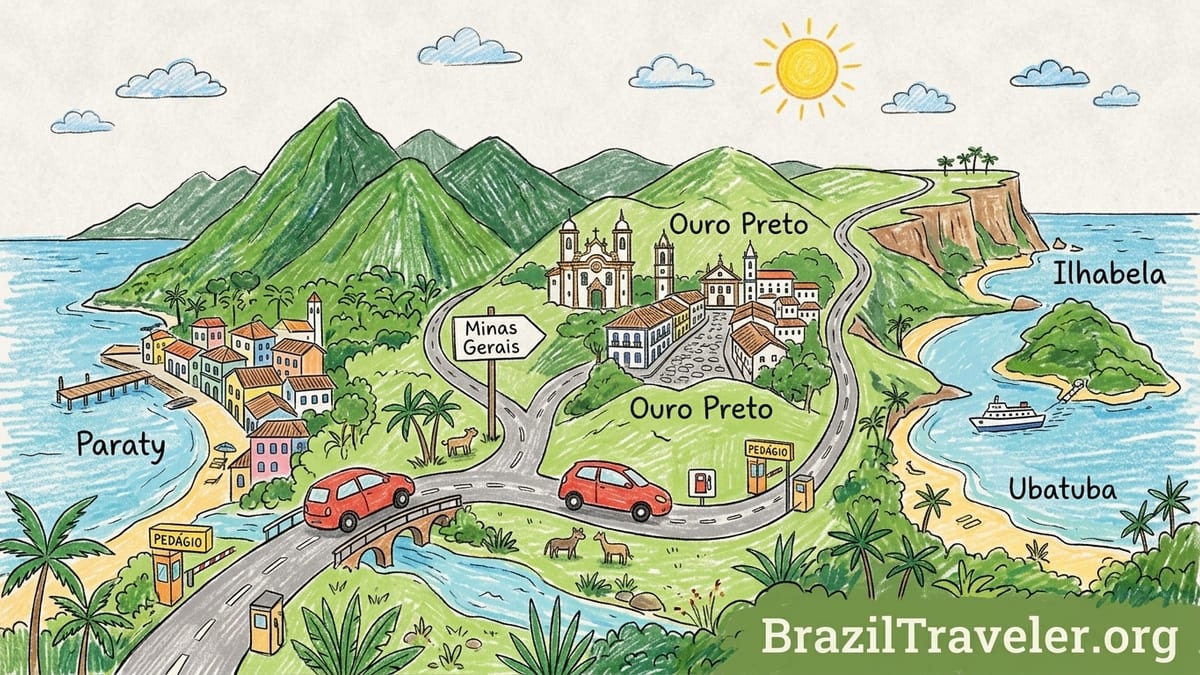
Before picking up the keys, I spent hours looking at maps and recent road advisories. Official Brazilian tourism sources put Paraty about 250 kilometers from Rio de Janeiro, which sounds temptingly close until you factor in coastal curves, tropical rain and transfers from the airport. I quickly realized that forcing one huge loop Rio to São Paulo to Minas Gerais and back would mean more time gripping the steering wheel than walking cobbled streets or hiking to waterfalls. So I broke the region into three clusters I could realistically drive: Rio to the Costa Verde and Paraty, São Paulo to the north coast around Ubatuba and Ilhabela, and a Minas Gerais circuit linking Belo Horizonte, Ouro Preto, Mariana, Congonhas, São João del Rei and Tiradentes.
For this trip I rented an economy hatchback, the kind of basic flex-fuel model every Brazilian family seems to own. In Rio and Belo Horizonte, major international brands shared the airport counters with local companies. In September 2026, rates for an economy car on online brokers and Brazilian comparators hovered roughly between R$130 and R$220 per day with unlimited kilometers, plus mandatory basic insurance charged per day. I accepted the rental company’s standard coverage and declined add-ons like roadside assistance, since Brazil’s main toll roads already include emergency support. The contract clearly excluded gravel damage and underbody hits, which shaped my decisions later on when small side roads turned to dirt.
At the desk I was reminded that both drivers needed to present a license, and that foreign visitors from the United States could use their home license with their passport for stays under 180 days. An International Driving Permit was recommended but not strictly required. The car came with a full tank and the usual rule: return it full or pay a steep refuelling fee. Fuel prices, according to Brazil’s official petroleum agency data in September 2026, were sitting around the mid single digits per liter in reais for gasoline in the southeast region, which meant roughly R$250 to R$300 to fill the small tank from near empty.
I also had to think about tolls. Brazil’s southeastern highways are among the most heavily tolled in the country. On the Rio to São Paulo axis, the BR-116 Presidente Dutra and its connecting spurs maintain multiple plazas where passenger cars pay a few reais each time. Government notices in 2026 reported tariff adjustments on BR-116, and independent toll calculators confirmed that a full Rio to São Paulo run in a small car can easily exceed R$70 in tolls one way, depending on the exact entry and exit points. My more modest clusters never hit that full amount in a single day, but I still kept a stack of small bills and a contactless card in the glove box for quick stops.
From Rio to Paraty: The Costa Verde by Wheel
My first cluster started at Rio de Janeiro’s Galeão International Airport. After clearing customs I followed the rental shuttle signs and collected the hatchback. Escaping Rio’s expressways was the most stressful part of the entire coastal drive. Lanes split and merged with little notice, motorcycles threaded between cars, and GPS instructions sometimes lagged behind real time. Once I swung south towards the Costa Verde, the traffic thinned and the scenery improved: sea on one side, forested mountains on the other.
The route from Rio to Paraty combines stretches of BR-101 with local connectors. Even though the straight-line distance is around 250 kilometers, the drive took me nearly five hours including a fuel stop and a coffee at a roadside service plaza. Road surfaces changed frequently. Newly resurfaced blacktop alternated with older sections where patched potholes created ridges. In daylight and dry conditions I found the curves manageable, but I would hesitate to recommend this drive to someone unused to Brazilian traffic after dark or in heavy rain. Passing lanes are not always clearly marked, and local drivers can be aggressive when overtaking slow trucks.
Tolls along this route were surprisingly modest compared with the full Rio to São Paulo corridor. Recent comments from Brazilian drivers in 2026 suggested that the total toll expenditure between Rio and Paraty in a passenger car is around R$20, split across a few plazas. That matched my own experience, as I handed over small notes at two different booths and rolled through one automatic lane where cash was still accepted. Although many locals use electronic tags, I managed the whole trip in cash by always merging into the marked “manual” lanes.
The real surprise came when I reached Paraty. The historic center, with its raised stone curbs and famously uneven cobblestones, is effectively car free. Guided resources about Paraty emphasize that cars are not permitted inside the core streets, and local officers were quick to whistle at anyone who attempted to nose in. I parked at a private lot just outside the stone gateway, paying around R$30 for a full day of parking. It was secure and convenient, but it also meant that once I was in town the car sat idle. Every beach boat trip, every stroll to the pier, every evening in a bar occurred within a few minutes’ walk. In Paraty, the car was crucial for reaching the town and exploring beaches and waterfalls in the surrounding area, but inside the center it was a clear liability.
São Paulo, Ubatuba, Ilhabela and Paraty: Linking the North Coast
My second cluster put the same rental car to better continuous use. From São Paulo city, I headed along the highway system that leads to the north coast. Modern dual carriageways carried me across the plateau before snaking down towards sea level. Tolls were more frequent here, and a quick check against a national toll calculator before departure had prepared me for around R$40 to R$60 in tolls between the capital and the Ubatuba region, depending on the precise route. Well-marked plazas and card payment kept things efficient, though lines built up near holiday weekends.
The descent from the plateau towards the sea was both beautiful and demanding. The road coiled through the Serra do Mar, and long trucks crawled uphill while impatient cars darted out to overtake. My little hatchback had just enough power to keep a comfortable pace, but I stayed tucked behind buses when visibility fell. In a heavier car or underpowered vehicle, I would allow extra time for this stretch, especially in the wet. Once down near the water, the highway became a ribbon connecting beach town after beach town.
Ubatuba was the first place where the car felt like real freedom. Over a long weekend I used it to hop between beaches spread along dozens of kilometers of coastline. Some coves had small, informal parking areas where entrepreneurial locals watched cars for a fee, which in my experience ranged from R$10 to R$20 for a few hours. In peak season, drivers on online forums in 2026 reported higher amounts, especially on New Year’s and Carnival weeks. I usually arrived before 9am to secure a spot and left by late afternoon to avoid being stuck in a slow crawl back into town.
From the Ubatuba region I continued along the coast towards São Sebastião, where ferries shuttle cars across to Ilhabela. The queue for the ferry is where I most felt the cost of traveling by car. On a Saturday morning I waited nearly ninety minutes in line, inching forward behind hundreds of other vehicles. When it was finally my turn, I paid the official tariff for a passenger car and rolled aboard. Online sources in 2026 put that car-and-driver charge in the tens of reais, with additional per-passenger fees. Once on Ilhabela, parking near the most popular beaches again meant negotiating with local attendants who unofficially “managed” curbside spaces. In some areas a formal municipal rotating parking system applied, with payment via app or scratch cards, but in practice I often ended up paying a man with a fluorescent vest to watch the car.
Back on the mainland, I had a choice. Many travelers combine São Paulo, Ubatuba, Paraty and then Rio by car. At that point, though, I had already experienced the Rio to Paraty drive in the opposite direction. I opted instead to loop back towards São Paulo on the inland highways, trading scenic curves for faster dual carriageways. That drive was straightforward but also the least interesting of the trip. Service plazas with branded fuel stations, chain restaurants and clean bathrooms broke the monotony. Tolls added up quickly, but the smooth asphalt and clear lane markings made for relaxed driving compared with the coastline.
Minas Gerais by Car: Ouro Preto, Mariana, Congonhas and Tiradentes
The Minas Gerais cluster was the one that most justified having a rental car. Public transport does connect Belo Horizonte to individual towns, but stitching together Ouro Preto, Mariana, Congonhas, São João del Rei and Tiradentes in a short time is far easier with your own wheels. From Belo Horizonte I followed the BR-040 towards Rio de Janeiro before branching off towards Ouro Preto, as recommended by the official Ouro Preto tourism website. The distance is around 100 kilometers, but the road climbs and curves through hills, so the trip took me about two hours.
BR-040 is a major federal highway and feels very different from the intimate coastal road to Paraty. It has long stretches of divided lanes, regular service areas and frequent police and toll presence. Tolls on the Rio to Belo Horizonte section have seen adjustments in recent years, and my specific Belo Horizonte to Ouro Preto segment included at least one plaza where I paid a little over R$10 for the passenger car category. The asphalt was generally good, though closer to the Ouro Preto turnoff the road narrowed and trucks slowed the flow.
Arriving in Ouro Preto, I immediately understood why many visitors leave their car parked for entire days. The town is a maze of steep cobbled streets, narrow one-way lanes and heavily used curb space. Municipal parking areas and private lots charge day rates that, based on my September 2026 visit and local comparisons, often ranged between R$20 and R$40 depending on proximity to the historic center. I chose a small pousada that offered a tight but secure garage space, which saved me from wrestling for street parking every evening. Once settled, I walked almost everywhere. The steep gradients were punishing on foot, but they would have been nerve wracking in the car, especially when reversing on stone slopes.
From Ouro Preto to Mariana, the drive is short but illustrative of why a car matters here. Recent heritage itineraries describe this link as about 12 kilometers along a curvy state road, and that matched my odometer. The drive took roughly half an hour each way, and let me visit Mariana’s main square and churches in a half day, then return to Ouro Preto for the evening. No bus timetable could have matched that flexibility. Road surfaces were fair but with some patched sections and occasional potholes on the shoulders. In the rainy season, rockfalls and minor landslides along Minas’ hill roads are not uncommon, so I checked state road advisories online before setting out each morning.
Extending the circuit, I drove from Ouro Preto through Congonhas, São João del Rei and on to Tiradentes. Different planning tools and recent Brazilian road trip reports place the full Belo Horizonte to Tiradentes distance around 190 kilometers, typically via BR-040 and BR-265, with Congonhas a logical stop roughly one-third of the way. I split this into stages, visiting Congonhas’ sanctuary and sculptures in a few hours before pushing on towards São João del Rei. The roads alternated between divided highway and narrower state routes, and while most of the surface was decent, some stretches had rough patches that kept my average speed lower than expected. By the time I rolled into Tiradentes in late afternoon, I had spent more time behind the wheel than sightseeing that day.
Driving, Tolls and Fuel: What It Really Cost Me
Looking back over my notes and credit card statements, the real cost of driving these clusters fell into three categories: rental, fuel and tolls, with parking as an important footnote. The rental car for just under two weeks, including basic insurance and airport fees but excluding fuel, came to a bit over R$2,000. This lined up with midrange market quotes I had found earlier in 2026 for similar durations and car categories. In pure money terms, that could have funded several long intercity bus journeys, but it also turned small gaps between destinations into spontaneous side trips.
Fuel was the variable I watched day by day. Official data from Brazil’s fuel regulator for September 2026 showed average gasoline prices in the southeast around the mid single digits per liter, with some variation between city and interior. My hatchback’s consumption hovered near 12 to 14 kilometers per liter in mixed driving. Over the whole itinerary I estimate I drove just under 2,000 kilometers, which meant something on the order of 150 to 170 liters of fuel. That translated into roughly R$800 to R$1,000 on fuel, depending on the precise pump prices I encountered in Rio, São Paulo’s interior and Minas.
Tolls were concentrated on certain axes. On BR-116 between Rio and São Paulo, official updates and independent road portals in 2026 documented tariff increases that pushed car tolls at individual plazas into the high single digits or low double digits in reais. I never drove the full length of that corridor in one go, but the partial segments I used between São Paulo and the coast, and between Belo Horizonte and the Rio direction, still added up. For my combined clusters, I paid somewhere between R$200 and R$250 in tolls across two weeks, based on receipts I kept tucked under the sun visor. Most plazas accepted cash and contactless cards, and a few had adopted electronic free flow systems where cameras read license plates and billed tag holders automatically. As a foreign visitor without a Brazilian tag, I always chose the clearly marked manual lanes to avoid any billing confusion.
Parking was the quiet cost that crept up on me. In Paraty and Ouro Preto, daily or overnight parking repeatedly hovered between R$20 and R$40. In coastal towns around São Paulo, beach parking was sometimes just a few reais passed to a local attendant, but during holiday weekends those unofficial rates climbed. In Ilhabela and Ubatuba’s central areas, official rotating parking systems imposed hourly caps, paid via app or kiosks. Since I did not have a Brazilian phone plan for local parking apps, I relied on physical scratch cards where possible or chose private lots that accepted cards. In total, parking for the whole trip likely consumed R$300 to R$400, a meaningful slice of the budget but also the price of convenience and security.
Road Surfaces, Mountain Passes and After-Dark Driving
Driving in southeast Brazil taught me that distance on a map says little about real travel time. Coastal roads between Rio and Paraty are twisty and, in places, narrow. Minas Gerais hill routes between Ouro Preto, Mariana and Tiradentes add vertical drama to every kilometer. Meanwhile, the big federal and state highways can lull you into a false sense of security until a sudden lane closure or summer storm interrupts the flow. I adopted a personal rule for this trip: wherever possible, I avoided starting new intercity drives after 4pm, especially on unfamiliar mountainous roads.
On the Rio to Paraty leg, I did one experiment with late driving that cured me of any romanticism about night journeys. I left Angra dos Reis in late afternoon and still had over 100 kilometers to Paraty as dusk fell. The final hour unfolded in darkness, with oncoming headlights glaring off wet asphalt after a brief tropical shower. Potholes that were easy to see by day became dark smudges. Local drivers seemed unbothered, overtaking on short straightaways, but I hugged the right side and let my speed drop. By the time I checked into my pousada I was tense and tired, and I vowed to keep future drives on that route firmly within daylight.
In Minas Gerais, the challenge was different. The road between Ouro Preto and Mariana, and the longer stretches towards Congonhas and Tiradentes, passed through a landscape of rolling hills cut by narrow river valleys. Daylight revealed rock faces that occasionally shed pebbles and debris onto the shoulder. I saw several warning signs about falling rocks and one stretch where road crews had recently cleared a minor slide. State highway updates for the region often mention temporary signalized one-way sections when maintenance is underway, and on one morning I did wait for nearly fifteen minutes at a portable traffic light while machinery worked up ahead.
The quality of road surfaces varied but was rarely catastrophic. Newer concessions around São Paulo and Rio offered smooth, well-marked lanes that felt similar to European motorways. Older stretches and some Minas state roads, by contrast, bore the scars of years of truck traffic and patchwork repairs. I learned to expect sudden ridges where past potholes had been filled, and I kept both hands firmly on the wheel when passing over them at speed. My economy car’s small wheels made every defect more noticeable, so someone particularly sensitive to ride comfort might prefer a slightly larger compact sedan.
Urban driving introduced its own set of challenges. In central Belo Horizonte and Rio, aggressive lane changes, motorbikes slipping between lanes and pedestrians appearing midblock tested my reflexes. Speed bumps, or lombadas, were omnipresent in residential areas and small towns. Many were painted and signed, but some on the approaches to beach parking areas appeared with minimal warning. Hitting one too fast would have risked exactly the underbody damage my rental contract excluded, so I stayed attuned to roadside hints like groups of parked cars or vendor stands. Those often signaled a bump or curb ahead, designed to slow traffic near crossings or popular spots.
When the Car Was a Blessing, and When It Got in the Way
Over the course of these clusters, I came to see the rental car as both enabler and occasional burden. In Minas Gerais it was almost entirely a blessing. The ability to leave Belo Horizonte early, reach Ouro Preto by mid morning, detour to Mariana after lunch, and still be back at my pousada by nightfall would have been impossible by bus. The towns themselves reward slow, on-foot exploration, but the spaces between them are where the car shines. Remote viewpoints, small roadside restaurants serving homemade Minas cheese and simple buffets, and lesser-known chapels only a few kilometers off the main roads all appeared spontaneously on my route.
On the São Paulo and Rio coasts, the calculation was more nuanced. Around Ubatuba and Ilhabela, the car meant I could chase good weather from one bay to the next, avoiding rain clouds that hung over some beaches while the sun shone twenty kilometers away. It also allowed me to arrive at trailheads for waterfalls or viewpoints that local buses did not reach easily. Yet in Paraty’s center, my car never ventured past the same private lot at the edge of the stone streets. The historic grid is built for pedestrians and horse carts, not modern vehicles. Boat tours to islands, guided walks along the old Gold Trail and evenings out all started and ended within a compact area where a car would only have taken up precious space.
Traffic and parking were the main reasons the car felt like a liability. On busy summer weekends, queues into coastal towns stretched for kilometers, and parking attendants waved cardboard signs promising vagas, or spaces, several blocks away from the beach. I watched buses glide past the jam in dedicated lanes on some approaches, and I briefly envied passengers who could read or nap instead of hovering over the clutch. In those moments, I understood why many travelers in 2026 online discussions still recommend using intercity buses to link Rio, São Paulo and Paraty, and then relying on local taxis or organized tours.
Another hidden cost of driving was how much it ate into my sightseeing hours. On paper, a 200 kilometer day looked manageable, but when I added up time for toll stops, fuel stations, coffee breaks, photo pauses and occasional slow stretches behind trucks, a “three hour” drive easily became five. In Minas, my day from Ouro Preto to Congonhas, then on to São João del Rei and Tiradentes, left me with only a late afternoon walk in Tiradentes before sunset. A bus might have taken similar total time, but at least I could have rested en route. Instead, I arrived somewhat drained and glad I had planned two full nights in town.
The Takeaway
Looking back, I am glad I resisted the temptation to draw a giant loop across the map of southeast Brazil. By breaking the region into practical clusters, I could combine the freedom of a rental car with enough time on the ground to absorb each place. The Rio to Paraty stretch gave me coastal drama and the clear lesson that some colonial centers are better explored without a steering wheel. The São Paulo to Ubatuba and Ilhabela cluster delivered beaches and ferry queues in equal measure, along with an appreciation for how quickly tolls accumulate on well maintained highways. Minas Gerais, with its network of historic hill towns, justified every liter of fuel and every mountain curve.
If you are considering a similar trip, think less about how many states you can tick off and more about how many mornings you can spend wandering cobbled lanes, climbing church towers and swimming in hidden coves. An economy rental car, booked from a major airport location, can cost in the low hundreds of reais per day once insurance and fees are included, and current fuel prices and tolls in 2026 will add a significant but manageable layer to your budget. In exchange, you gain the ability to link Rio to the Costa Verde, São Paulo to the north coast and Belo Horizonte to the Estrada Real towns on your own schedule.
Most importantly, be realistic about driving conditions. Mountain passes and coastal curves reward caution, and night driving can quickly turn a scenic route into a stressful chore. Plan your days with generous buffers, keep a close eye on changing toll rates and road works, and choose accommodations with parking in towns where curb space is scarce. Used thoughtfully, a car in southeast Brazil is not about racing from Rio to São Paulo and back, but about stitching together a handful of rich, memorable clusters that reveal how mountains, colonial history and the Atlantic coast meet.
FAQ
Q1. Is it better to rent a car or use buses between Rio, São Paulo and Paraty?
For direct travel between the big cities and Paraty, buses are comfortable and affordable, while a car offers flexibility for side trips and beaches but adds tolls and parking hassles.
Q2. How long does it really take to drive from Rio’s airport to Paraty?
Although the distance is around 250 kilometers, traffic leaving Rio, curves on the coastal road and stops mean most drivers should expect about four and a half to five hours.
Q3. Are Brazilian tolls expensive on these routes?
Tolls vary by highway, but on major corridors like BR-116 and the São Paulo coastal access roads, expect to spend several tens of reais per long driving day in a passenger car.
Q4. Do I need an International Driving Permit to rent a car in Brazil?
Most rental companies accept a valid foreign license with a passport for stays under 180 days, though an International Driving Permit is recommended and may simplify any police checks.
Q5. Is it safe to drive at night between coastal towns and in Minas Gerais?
It is legal but not ideal. Curvy roads, occasional potholes, heavy rain and glare from oncoming headlights make daytime driving significantly safer and less stressful.
Q6. What kind of car is best for a road trip through southeast Brazil?
An economy hatchback handles highways and most town streets well, but a slightly higher-clearance compact can be more comfortable on rougher Minas backroads and beach access lanes.
Q7. How is parking in historic towns like Paraty, Ouro Preto and Tiradentes?
Paraty’s historic center is essentially car free with paid lots on the edge, while Ouro Preto and Tiradentes rely on tight garages, private lots and limited street spaces that fill quickly.
Q8. Are mountain and coastal roads well maintained?
Main tolled highways are generally in good condition, but some coastal segments and Minas hill roads show patches, ridges and occasional work zones that call for moderate speeds and attention.
Q9. How much did fuel cost for a two-week trip like this?
With mid single digit gasoline prices per liter in the southeast in 2026 and an efficient small car, a roughly 2,000 kilometer itinerary can easily consume around R$800 to R$1,000 in fuel.
Q10. Can I rely on card payments for tolls, fuel and parking?
Most fuel stations and toll plazas accept cards, and many parking lots do as well, but it is still wise to keep small amounts of cash for informal parking and minor roadside purchases.