


Iguaçu National Park on the Brazilian side of Iguazu Falls is one of South America’s most impressive natural attractions and the flagship experience of South Brazil. In 2026, Foz do Iguaçu combines dramatic scenery with strong infrastructure for ticket bookings, guided excursions and varied accommodation. This guide focuses on the Brazilian park, explaining exactly how admission works, what Macuco Safari includes, how to time your visit and which extras are genuinely worth paying for.
How Iguazu Falls works on the Brazilian side in 2026
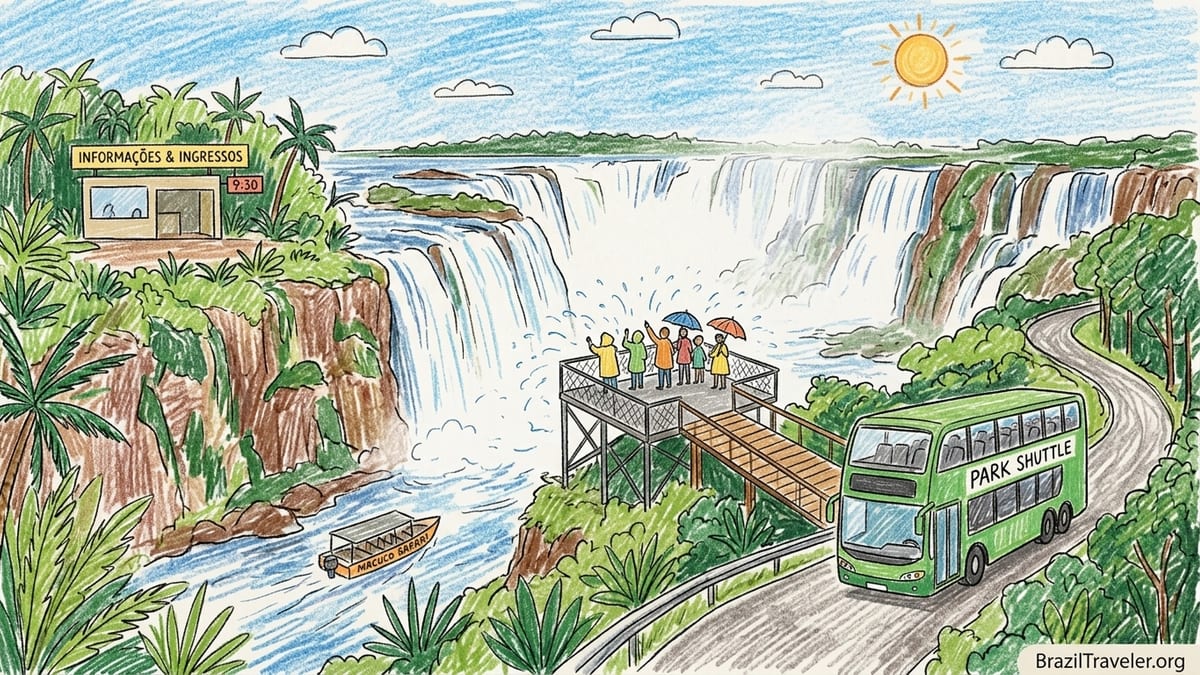
The Brazilian side of Iguazu Falls is protected inside Parque Nacional do Iguaçu, about 20 kilometers from central Foz do Iguaçu on the BR-469 road. All regular visits start at the modern Visitor Center, where entrance tickets are checked and shuttle buses depart along the park road to the main viewpoints. You cannot drive your own car to the falls viewpoint; even drivers must park at the Visitor Center and use the internal shuttle system that is included in the admission price.
In 2026, the official Brazilian park operator lists standard entrance at around R$134 for general international visitors and R$121 for Brazil and Mercosur nationals, with children up to 6 years old entering free of charge. These values match current figures used by regional tourism boards and visitor guides for tickets valid from late 2025 onwards. General admission includes access to the Cataratas walking trail, viewpoints over the main wall of waterfalls, the metal walkway that reaches into the mist in front of the Devil’s Throat and unlimited use of the official shuttle buses during your visit.
What general admission does not include are the “optional experiences” sold by the park’s concessionaire and by private companies inside the park. Boat trips with Macuco Safari, early-morning “Amanhecer nas Cataratas” sunrise entries, night experiences, guided bicycle tours and longer eco trails such as Poço Preto or Bananeiras are all priced independently from the base entrance ticket. A typical mistake is to assume that the Macuco Safari boat ride is part of the park ticket; it is not, and you must budget and book it separately.
The Brazilian side offers a single main viewing trail, which makes logistics simpler than on the Argentine side. Most visitors spend between 3 and 5 hours inside the park, although a full day is easily filled if you add Macuco Safari or a premium sunrise slot. Shorter visits work well for travelers based in Foz do Iguaçu who also want to see Parque das Aves or Itaipu Dam on the same day, while those coming only once in a lifetime often invest in a longer stay in the park.
Tickets, timed entry and opening hours
Official entrance tickets for the Brazilian side are sold through the park operator’s online system and at the Visitor Center ticket office. Buying online is strongly recommended in 2026 because daily visitor numbers can be high in holiday periods and online tickets allow you to choose a specific entrance time. Travelers in July, on Brazilian school holidays or long weekends such as Carnival and New Year, report that morning slots may sell out a day or two in advance, although same-day tickets are typically still available for later in the day.
When you purchase online, you select a date and a time window, for example 9:00 to 9:30. This is the period when you are expected to pass the turnstiles at the Visitor Center, not when you must leave the park. Once inside you can stay until closing time. Independent reports from 2025 and 2026 visitors describe that staff are flexible within about 30 minutes on quieter days but become stricter when the park is busy, so it is wise to arrive at least 20 to 30 minutes before your booked slot to account for queuing and any issues with QR codes or ID checks.
The park generally opens earlier on weekends and holidays than on weekdays. Recent schedules show weekday operations commonly starting around 9:00 with last entrance at 16:00, while weekend and high-season opening can shift earlier, with shuttle operations starting around 8:30 and final entry extended to late afternoon. During peak vacation periods, such as the 2025–2026 summer break, the park has temporarily operated with longer daily hours from approximately 8:00 to 16:00 to handle demand. Because hours can vary with season and special programs, travelers visiting in 2026 should confirm the exact timetable for their travel dates during ticket purchase rather than relying on a static schedule.
Children, seniors and students from Brazil often benefit from reduced entrance fees when they present appropriate ID, but foreigners should not assume they qualify. The prices stated at the beginning of this guide, R$121 for Brazil and Mercosur residents and R$134 for other international visitors, are the key benchmarks for independent travelers planning ahead for 2026. Remember that this covers your national park admission and shuttle buses but not parking, lockers, food or extra activities.
Cataratas main trail and Devil’s Throat viewpoints
After passing the turnstiles at the Visitor Center, you board a double-decker green shuttle bus for the 10–12 kilometer ride along the forest road. Most visitors stay onboard until the “Trilha das Cataratas” stop, where the main walking trail begins. From here a paved and well-maintained path follows the rim of the canyon, offering a series of balconies and side-path viewpoints that look across to dozens of separate falls on the Argentine side and down into the gorge.
The full Cataratas trail is about 1.5 kilometers long one way from the first viewpoint to the final elevator up to the Porto Canoas area. Including photo stops, most people take 1.5 to 2.5 hours to walk the trail at a relaxed pace. Surfaces are mostly flat or gently descending, but there are staircases at some points. The most famous stretch is the metal walkway that extends over the river in front of the Devil’s Throat, where visitors are surrounded by spray and thunderous noise. Expect to get at least partially wet here, especially on windy days when the mist blows back across the platform.
At the end of the walkway you take an elevator up to the upper viewpoint and the Porto Canoas complex, which has restaurants, snack counters, a gift shop and restrooms. From this area you can either continue exploring on foot or board a shuttle bus back to the Visitor Center and parking area. Families with young children and travelers with limited time sometimes choose to ride the bus part way and start the trail closer to the Devil’s Throat, but walking the full route gives a satisfying build-up from panoramic distant views to close-up encounters with the waterfalls.
Accessibility is better on the Brazilian side than on many waterfall destinations but still has limitations. The shuttle buses are designed to accommodate passengers with reduced mobility, and much of the main path is paved and relatively smooth. However, some viewpoints are reached via stairs, and the walkway near the Devil’s Throat is exposed, wet and can be slippery. Visitors using wheelchairs or strollers typically focus on the upper viewpoints and Porto Canoas area and may rely on assistance to navigate some sections of the trail. For travelers comparing sides, the Brazilian side provides sweeping postcard views and is easier to cover in half a day, while the Argentine side offers longer walking circuits and closer contact with the individual falls.
Macuco Safari: jungle truck and boat into the falls
Macuco Safari is the iconic boat experience on the Brazilian side and a separate company that operates within Iguaçu National Park. Its standard package combines three phases: a guided ride on open-sided electric or combustion vehicles along a 3-kilometer jungle track, an optional short walk or electric cart to the river, and a high-powered boat ride that approaches and partially enters some of the side waterfalls. The boats do not go directly under the main Devil’s Throat but still guarantee a full drenching and dramatic views.
In 2026, Macuco Safari advertises its standard jungle-and-boat experience at around R$384 per adult, a figure confirmed by multiple regional operators and promotions. This price is per person and does not include the national park entrance ticket. Children generally receive discounted rates, with some providers noting that kids up to 5 or 6 years old may ride for free or at reduced cost, but details vary by promotion and should be confirmed at the time of booking. The company sells tickets both at its reception center inside the park and through online agents and local travel agencies.
The total duration for the Macuco Safari experience is typically around 1.5 to 2 hours, depending on waiting times at the dock. Travellers who prebook a mid-morning or early-afternoon departure can comfortably combine the boat trip with walking the main Cataratas trail before or after. For example, many visitors catch an early shuttle bus, walk part of the trail with morning light, then ride another shuttle to the Macuco stop for an 11:00 or 12:00 Macuco Safari departure. Others prioritize the boat first, especially on very hot summer days, so they can dry off while walking later.
For safety, Macuco Safari provides lifejackets and typically requires passengers to be above a minimum age or height for the most intense routes. Recent Brazilian media coverage of accidents on boat rides at the falls has led to renewed emphasis on following staff instructions, securing cameras and not attempting risky selfies during the splash sections. Travelers who prefer to stay dry can ask about a “dry seat” position, although even these spots often end up sprayed. Waterproof phone pouches are widely sold in Foz do Iguaçu and at souvenir stalls in the park, and they are a practical purchase if you plan to film during the ride.
Premium experiences: Amanhecer nas Cataratas and more
Beyond the standard day visit, Iguaçu National Park offers several premium experiences that appeal to photographers and repeat visitors. The most notable is “Amanhecer nas Cataratas,” a sunrise opening that allows a limited number of guests to enter the park well before the general public. According to recent visitor information published by the regional tourism organization, this program usually runs on select days, often Thursdays and Saturdays, with check-in at the Visitor Center around 5:30 to 6:00 in the warmer months. Participants board a special shuttle, reach the viewing area as the first light hits the mist and then have time for quiet photography before the regular crowds arrive.
The sunrise experience is priced separately from regular admission and can be sold either as a package that already includes park entry or as an add-on combined with a separate ticket. Prices in 2026 vary by operator and are often bundled with breakfast at the Porto Canoas restaurant or at nearby hotels such as the luxury property located inside the park. As a reference, premium sunrise or combined sunrise-and-breakfast offerings tend to cost significantly more than a standard ticket and can approach or exceed the cost of Macuco Safari, but the value lies in near-empty walkways and soft early-morning light. Serious photographers and travelers who dislike crowds consistently rate this as one of the best ways to experience the falls.
Other premium or special experiences promoted in recent years include sunset and night-time events, star-gazing from selected mirantes, longer guided hikes like Poço Preto and Bananeiras, and cycling circuits inside the park. Many of these have their own pricing structures and schedules and are occasionally adjusted or paused, so anyone planning specifically around them for 2026 should check current offerings directly with the park concessionaire or a trusted local agency closer to the travel date.
These programs illustrate the key distinction between general park admission and paid add-ons. Your base ticket is always required first and grants access during standard opening hours. Then you decide whether to upgrade your visit with sunrise access, a boat ride, a long trail, or a guided package. Booking the optional activities online in advance usually secures preferred times and avoids disappointment, especially in Brazilian holiday periods, but last-minute spots are sometimes available on quieter weekdays outside school vacations.
Getting to the park from Foz do Iguaçu
Reaching the Brazilian falls from central Foz do Iguaçu is straightforward and does not require an organized tour. The most budget-friendly option is public bus line 120, signed “Parque Nacional” or “National Park,” which runs from the city’s main TTU bus terminal along Avenida das Cataratas, passing major hotels, the airport and Parque das Aves before ending at the park entrance. Timetables published in 2026 show regular services every 20 to 30 minutes during the day on weekdays, Saturdays and Sundays, with slightly reduced frequency at the extremes of the schedule.
A typical one-way journey from central Foz to the park entrance takes around 30 to 40 minutes, depending on traffic and intermediate stops. Tickets are purchased on board with cash or local payment methods and usually cost only a fraction of a taxi fare. Concrete examples from recent visitors describe leaving the TTU around 8:00, reaching the park before 8:40 and joining the queue for a 9:00 entrance slot. For travelers staying at hotels along Avenida das Cataratas, many of which sit directly on the bus route, this is a particularly convenient choice.
Taxis and app-based rides such as Uber and 99 are widely available in Foz do Iguaçu and provide faster, more direct trips to the park. In 2026, visitors often report one-way prices that are still relatively affordable by international standards, especially when shared among three or four people. There is a dedicated drop-off and pick-up area in front of the Visitor Center. Private transfer companies and hotels also offer fixed-price shuttles, which can be worthwhile for families with children or travelers connecting directly from the airport to the park.
Driving yourself in a rental car is simple, since BR-469 is clearly signposted and the national park entrance sits near the end of the road. Parking at the Visitor Center is charged separately from the entrance ticket, with a flat fee per vehicle. For example, recent guidance from Brazilian travel sites refers to passenger car parking fees that add a noticeable but manageable extra cost to a day in the park. Motorists should remember that after parking they will still need to ride the official shuttle to reach the viewpoints. Because access logistics are so straightforward, most independent travelers do not need to purchase transport-inclusive tour packages only to get from town to the park.
Guided tours, what to book and what to skip
The strong tourism industry around Foz do Iguaçu means there is no shortage of agencies offering packaged tours to the Brazilian falls. Options range from simple transfers with a guide who escorts you through ticket checks to all-inclusive day trips that bundle park admission, Macuco Safari, meals and sometimes a side visit to Parque das Aves or Itaipu Dam. While some travelers appreciate the convenience, many of these packages simply combine elements that you can book yourself and add a significant markup.
The key is to understand what you gain by paying for a guide. A reputable bilingual guide can be valuable if you want in-depth natural history commentary, help with photography spots, time management advice, or if you are nervous about language barriers when dealing with ticket machines and public buses. Small-group tours that cap participant numbers and focus tightly on the Brazilian side can be good value, especially for solo travelers or couples without their own transport who prefer an English-speaking escort.
On the other hand, tours that primarily bundle park admission and Macuco Safari without adding real expertise or unique timing are often unnecessary. For instance, some international platforms sell day packages that include hotel pickup, entrance ticket and Macuco Safari for a total price that, when broken down, is significantly higher than simply buying your own park ticket online, catching bus line 120 to the entrance and purchasing Macuco directly. Independent budget travelers, particularly those already used to navigating Latin American bus systems, usually prefer the flexibility and savings of doing it themselves.
When evaluating offers, look closely at whether entrance fees and Macuco Safari are actually included or only “assisted.” Some cheaper tours list these as optional extras to be paid in cash on arrival, which can cause confusion. For travelers with limited time, a well-reviewed private guide who arranges tickets and logistics in advance and structures the day to avoid peak bottlenecks at viewpoints and shuttle stops can be a smart investment, but in most cases you do not need a tour simply to access the Brazilian side of the falls.
Weather, walking conditions, accessibility and photography
Iguazu Falls is a year-round destination with a subtropical climate. Analysis of recent climate data for the region shows that October is often among the wettest months, with heavy showers and high humidity, while June and July are cooler and somewhat drier. Summer daytime highs in January and February regularly reach 30 degrees Celsius or more, and humidity adds to the feeling of heat. Whatever the season, visitors should expect spray, wet surfaces and at least the possibility of rain.
For walking, closed-toe shoes with good grip are safer than sandals, particularly on the metal walkways leading to the Devil’s Throat platform, which can be slick. Lightweight rain jackets or ponchos are useful but will not keep you entirely dry on Macuco Safari or in heavy spray; many travelers carry a spare T‑shirt or change of clothes in a small daypack. Simple plastic ponchos and waterproof phone pouches are widely sold both in town and at the park’s souvenir kiosks, although buying them in Foz do Iguaçu supermarkets is often cheaper.
Accessibility considerations matter for many visitors. The main shuttle buses are designed to accommodate passengers with reduced mobility, and elevators serve the upper viewpoint at Porto Canoas. However, not all lookout platforms along the trail are step-free, and the intense spray can pose challenges for those with visibility or balance issues. Travelers using wheelchairs or pushing strollers often choose to focus on the Visitor Center facilities, shuttle viewpoints and Porto Canoas rather than attempting every side trail. Communicating your needs at the entrance allows staff to point out the most suitable routes.
For photography, the Brazilian side is renowned for its panoramic angles. Morning visits often provide softer light on the curtain of falls opposite the main trail, while late afternoon can produce rainbows in the mist. Serious photographers bring lens cloths, microfiber towels and sometimes simple plastic covers to protect equipment from spray near the Devil’s Throat. Using a wrist strap instead of a neck strap is common in the wettest sections, and many visitors leave interchangeable-lens cameras in the bag for Macuco Safari, relying instead on waterproof action cameras mounted on chest harnesses or head straps.
Food, visit duration and combining with Parque das Aves or Itaipu
Food options around Iguazu Falls on the Brazilian side are practical rather than gourmet but perfectly adequate for a day out. Inside the park, the Porto Canoas restaurant at the end of the main trail offers buffet or à la carte lunches with views of the river and upper falls, along with snacks, drinks and ice cream. There are also snack bars near the Visitor Center and at some shuttle stops. Prices are higher than in central Foz do Iguaçu but reasonable given the setting and logistics of supply.
Most independent travelers spend between half a day and a full day at the Brazilian falls. A common pattern is to enter the park mid-morning, walk the main trail, have a late lunch at Porto Canoas and exit by mid-afternoon. Those who add Macuco Safari or sunrise experiences will often be inside the park for 6 to 8 hours. In practical terms, a first-time visitor who wants to enjoy the viewpoints without rushing and perhaps include Macuco has an excellent experience with one full day on the Brazilian side alone.
Combining the Brazilian falls with Parque das Aves is especially easy because the bird park sits almost opposite the national park entrance along BR-469. Many itineraries from 2025 and 2026 recommend visiting Parque das Aves either early in the morning before a later park entrance time or in the afternoon after a morning at the falls. For example, you might catch the 8:00 bus from town, spend two hours among toucans and macaws at the bird park from 8:30 to 10:30, then walk to the national park entrance for an 11:00 admission slot.
Adding Itaipu Dam on the same day as the Brazilian falls is more challenging and often feels rushed. Itaipu sits to the north of Foz do Iguaçu and its tours operate on a fixed schedule. While it is physically possible to start with an early-morning short visit at the falls and then take an afternoon panoramic tour of Itaipu, many travelers and local experts advise splitting them into separate days. This allows more flexibility for weather changes, avoids rushing shuttles and queues, and gives you time to enjoy sunset viewpoints or dinner in town without exhaustion.
Cost comparison for 2026: independent and packaged options
To help with budgeting, the following approximate cost scenarios illustrate how expenses stack up for a visit in 2026. All figures are indicative and use the official park and Macuco Safari prices mentioned earlier, excluding exchange-rate fluctuations and special promotions.
For a basic independent visit, a foreign adult buys general park admission at around R$134 and reaches the park using public bus line 120 for a modest fare each way. Assuming negligible bus cost compared with attraction fees, a rough total for entrance plus local transport could be considered about R$140 for the day. Lunch or snacks inside the park might add another R$60 to R$100, depending on choices, leading to a realistic door-to-door budget of R$200 to R$250 for a simple Brazilian-side experience without extras.
Adding Macuco Safari at the publicly advertised R$384 per adult immediately raises the total. Keeping the same assumptions for food and basic logistics, a foreign visitor now pays around R$134 for admission plus R$384 for Macuco, or roughly R$518 before meals. Including modest dining and small incidental expenses, a realistic total might sit between R$580 and R$650 for a park day with the classic boat ride.
Standard guided excursions sold by local agencies frequently bundle hotel pickup and drop-off with entrance tickets. Some include Macuco Safari, while others sell it as an optional extra. For example, a tour might charge a per-person rate that, after subtracting the known values of R$134 for admission and an estimated R$40 to R$60 share of transport costs, implies a substantial margin for guiding services. Premium sunrise packages such as Amanhecer nas Cataratas, especially when coupled with breakfast or small-group guiding, can reach or exceed the combined cost of admission and Macuco, but in return they provide rare empty-landscape conditions and curated photography moments that many enthusiasts find justify the extra outlay.
Looking at these scenarios in simplified table terms, a rough comparison for one international adult in 2026 could be summarized as follows: independent admission around R$134; park plus Macuco Safari around R$518 before food; standard small-group guided excursion including park ticket but excluding Macuco somewhere in between, often in the R$300 to R$450 range depending on inclusions; and premium sunrise packages typically higher still, especially when paired with private guiding. The exact prices you see will vary by season and retailer, but understanding the building blocks allows you to evaluate whether a given package represents genuine value or simply convenience.
The Takeaway
For 2026 travelers, the Brazilian side of Iguazu Falls offers a clear, well-organized experience that balances accessible infrastructure with spectacular scenery. General admission to Iguaçu National Park gives you everything you need for classic postcard views along the Cataratas trail and at the Devil’s Throat viewpoints, while optional upgrades like Macuco Safari and the Amanhecer nas Cataratas sunrise program allow you to personalize your visit according to budget and interests.
Families with young children often do best with a straightforward half-day or full day in the park, using shuttle buses, walking the main trail at a relaxed pace and incorporating plenty of photo and snack stops. The simplicity of the Brazilian layout reduces the risk of getting lost or overtired, and pairing the falls with nearby Parque das Aves gives kids variety without long travel times. Public bus line 120 and widely available taxis make transport easy, so there is rarely a need to pay extra solely for organized transfers.
Photographers and nature enthusiasts should seriously consider premium experiences. A sunrise Amanhecer slot on a Thursday or Saturday, followed by a mid-morning Macuco Safari and a quieter late lunch at Porto Canoas, creates a full day of changing light and perspectives that many describe as unforgettable. For this group, planning and prebooking matter more than cutting every possible cost, and the reward is time on the walkways when only a handful of other visitors are present.
First-time visitors who only have one full day for the Brazilian side will not feel short-changed. A well-structured day can cover the entire Cataratas trail, key viewpoints, a boat ride and an unhurried meal. However, if you also hope to see the Argentine side, Itaipu Dam and Parque das Aves, two or three days in Foz do Iguaçu is far more comfortable. The decision on whether one full day is enough depends less on logistics, which are straightforward, and more on how deeply you want to immerse yourself in the falls. For many travelers, the Brazilian side alone, done properly, becomes the standout memory of their time in South Brazil.
FAQ
Q1. Is one full day enough for the Brazilian side of Iguazu Falls?
For most first-time visitors, one full day is enough to walk the main Cataratas trail, enjoy all the major viewpoints and fit in either Macuco Safari or extended photo stops. Travelers who want both Macuco Safari and a premium sunrise experience may prefer to spread activities over two mornings or add an extra night in Foz do Iguaçu for a more relaxed pace.
Q2. Do I need to book my Iguazu Falls Brazil ticket in advance for 2026?
Advance booking is strongly recommended, particularly in Brazilian school holidays, long weekends and the Southern Hemisphere summer. The official system lets you choose a timed entry slot, and visitors in 2025 and 2026 note that early-morning times can sell out a day or two ahead in peak periods. Outside holidays, same-day tickets are usually available but may involve queuing at the Visitor Center.
Q3. What is the difference between park admission and Macuco Safari?
Park admission, around R$134 for international visitors in 2026, covers entrance to Iguaçu National Park, shuttle buses and access to all standard viewpoints and the main trail. Macuco Safari is a separate jungle-truck and boat experience inside the park that costs about R$384 per adult and must be paid independently. You cannot do Macuco Safari without a valid park ticket, and the boat ride is not included in general admission.
Q4. How do I reach Iguazu Falls from central Foz do Iguaçu without a tour?
You can take public bus line 120 from the main TTU terminal or along Avenida das Cataratas, which stops at many hotels, the airport, Parque das Aves and finally the park entrance. The journey takes roughly 30 to 40 minutes. Alternatively, taxis and app-based rides like Uber provide direct transfers at moderate prices, and rental cars can be parked at the Visitor Center for a separate parking fee.
Q5. What are the usual opening hours of Iguaçu National Park on the Brazilian side?
Opening hours vary slightly with season and special programs, but a typical pattern is entry from around 9:00 to 16:00 on weekdays, with earlier opening and sometimes slightly extended closing on weekends and holiday periods. During peak vacation times, the park has opened from approximately 8:00 to 16:00 to accommodate demand. Because the schedule can change, always confirm the exact hours for your travel date when purchasing tickets.
Q6. Is the Brazilian side of Iguazu Falls suitable for visitors with limited mobility?
The Brazilian side is comparatively accessible. Shuttle buses are designed for passengers with reduced mobility, main paths are paved and there are elevators at the Porto Canoas viewpoint. However, some lookouts involve stairs, and sections near the Devil’s Throat can be wet and slippery. Wheelchair users and those with balance issues usually focus on the Visitor Center area, shuttle-accessible viewpoints and Porto Canoas, sometimes with assistance from companions or staff.
Q7. How wet will I get on the Devil’s Throat walkway and Macuco Safari?
On the Devil’s Throat walkway you can expect to be misted, and on windy days parts of your clothes may become quite wet. On Macuco Safari you should assume you will be thoroughly soaked from head to toe as the boat intentionally approaches the base of smaller waterfalls. Bringing a change of clothes, using a lightweight poncho and protecting electronics with waterproof pouches are all sensible precautions.
Q8. Can I combine Iguazu Falls with Parque das Aves or Itaipu Dam in one day?
Combining the Brazilian falls with Parque das Aves is straightforward because the bird park is located near the national park entrance. Many visitors spend half a day at the falls and two to three hours at Parque das Aves on the same day. Adding Itaipu Dam as well is technically possible but usually feels rushed; most travelers prefer to allocate a separate half-day or full day to Itaipu for a comfortable visit.
Q9. Is a guided tour necessary for the Brazilian side of the falls?
A guided tour is not necessary for navigation or basic logistics, since public transport, signage and the single main trail make independent visits easy. However, a knowledgeable bilingual guide can enhance the experience with ecological explanations, local history, help with photography spots and time-saving strategies. Small-group or private tours can be worthwhile for travelers who value commentary, are short on time or prefer not to handle ticketing and transport alone.
Q10. When is the best time of year to visit Iguazu Falls in Brazil?
Iguazu Falls is impressive year-round. Summer months from December to February bring higher water flows and very hot, humid conditions, while winter months from June to August are cooler and somewhat drier, making walking more comfortable. October and other spring months can be wet but also dramatic, with strong mist and frequent rainbows. For a balance of manageable temperatures and good water volume, many travelers aim for autumn or late winter, but your choice may ultimately depend on wider Brazil travel plans.